


Domena A. Agyeman, UCCE Agricultural Economic Advisor; Butte, Glenn, and Tehama Counties
Becky Wheeler-Dykes, UCCE Orchard Systems Advisor; Glenn, Tehama and Colusa Counties
Cropload management is one of the most important practices in prune production. Timely and appropriate (fruit per tree) thinning can improve fruit size, enhance quality, increase market price, and ultimately boost grower return. However, with rising operational costs many growers are questioning whether thinning is still economically justified this season.
Even under higher cost conditions, thinning can remain economically beneficial depending on how it affects yield, fruit size, and market price. The key is to compare the benefits against the costs rather than relying solely on rising expenses. Growers should carefully assess their desired and actual fruit load before deciding whether to thin. This article provides a step-by-step guide on how to assess cropload and determine whether thinning is needed.
This year, elevated diesel prices can significantly increase the cost of mechanical operations. Global supply disruptions following the U.S.–Israel strikes on Iran have affected oil flows through the Strait of Hormuz, contributing to fuel price increases. In California, these pressures have been amplified by limited pipeline connectivity and reduced in-state refining capacity due to refinery closures. Between March 2, and April 6, 2026, diesel prices in California rose by approximately 51%, from $4.99 to $7.57 (Figure 1). As a result, custom farming rates for thinning have likely increased.
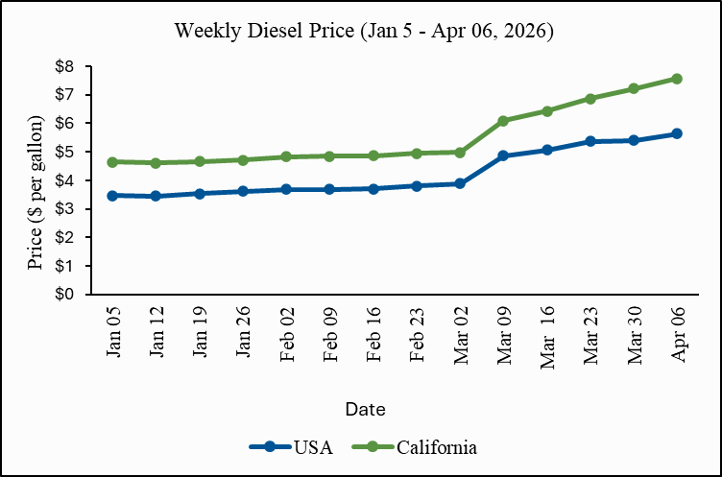
Figure 1: Weekly Diesel Price (Jan 5 – Apr 06, 2026). Source: US Energy Information System
For reference, the 2022 UC ANR cost study for Sacramento Valley prunes estimated mechanical thinning at $85 per acre when performed by custom operators. That $85 pass would equal roughly $93 per acre in today’s dollars if adjusted for general inflation. With the increase in diesel prices and labor costs, custom operators may quote significantly more.
Given these rising costs, it is understandable that growers may reconsider thinning. However, avoiding thinning without evaluating its economic impact could lead to unintended losses in fruit quality and revenue.
Partial budgeting is a simple and effective tool for evaluating whether a farm management decision will improve profitability. It focuses only on the revenues and expenses associated with a proposed change. You simply answer four key questions:
- What will be the new or added revenues?
- What costs will be reduced or eliminated?
- What will be the new or added costs?
- What revenues will be reduced or lost?
Then you calculate the net change in profit as:
(Added Revenue + Reduced Costs) – (Added Costs + Reduced Revenue)
Example scenario:
Suppose you manage a 100-acre mature prune orchard. This spring, your cropload assessment indicates that thinning is needed. Your custom operator has raised their rate to $150/acre, citing increased diesel and labor costs. This is much higher than you anticipated, and you are now wondering whether thinning is still worthwhile.
Without thinning, you expect a yield of 4.0 dry tons per acre, but the smaller fruit size would likely bring a price of $1,800/ton. If you thin, you anticipate 3.5 dry tons per acre, but the larger, higher-quality fruit would command a price of $2,100 /ton. You would also save $30/acre each in hauling and drying costs due to better fruit size and improved dry-away.
In this made-up example, thinning delivers a price premium of $300 per ton ($2,100 vs. $1,800). However, this comes at the cost of sacrificing 0.5 dry ton per acre in yield (from 4.0 to 3.5 tons). When these changes are organized into a partial budget (Table 1), they show a positive net change of $60/acre ($6,000 across the 100 acres). This indicates that the additional revenue from higher-quality fruit, combined with savings in hauling and drying costs, more than offsets the thinning cost and the loss in yield. Therefore, thinning would be the more profitable option.
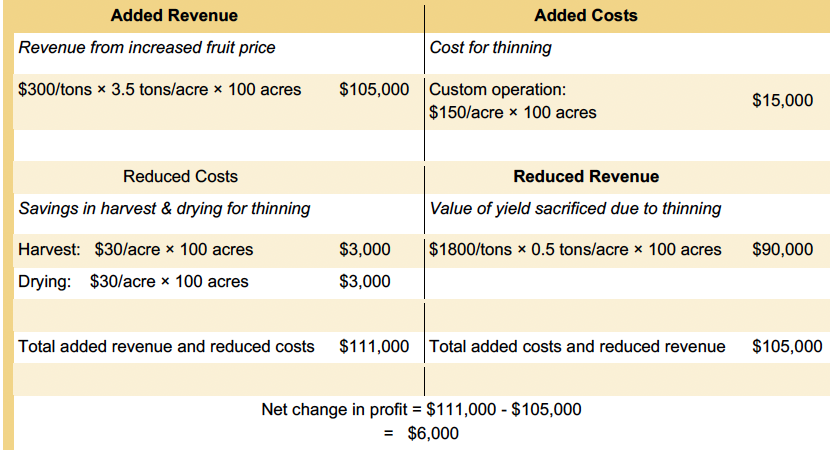
Table 1. Partial budget for a 100-acre prune orchard thinning
The purpose of this article is to highlight why thinning decisions should not be based solely on the rising cost of mechanical services. While skipping thinning may save money upfront, it can lead to over cropping: smaller fruit, lower quality, higher drying costs, and increased risk of alternate bearing leading to fewer flowers and a smaller crop next year. Instead, it’s worth running a partial budget using realistic numbers from your own orchard to get a clearer picture of whether thinning is still worthwhile. Trying a range of cost, yield and price scenarios can also help you see how sensitive your returns are and make more confident decisions under uncertain conditions.
Leave a Reply