


Franz Niederholzer, UCCE Farm Advisor, Colusa, Sutter, Yuba Counites
Bottom line:
In many prune orchards in the Yuba City/Gridley area, it looks like a decent to good crop set, but early bloom + warm post-bloom weather may deliver:
- early reference date (April 13-16 this year?)
- a relatively poor fruit sizing year (early thinning, where needed, should improve final dried fruit size)
- early harvest (first week of August for Yuba City?)
The rest of the story:
In peaches and prunes, heat units are measured as Growing Degree Hours (GDH) and the total of those heat units in the first 30 days after full bloom are reported as GDH30. Current (2026) GDH30 values for Sutter Co are 15-25% higher than any of the last five years. The last time GDH30 was this high (8300) was 2019. Higher GDH30 indicates an increased chances of 1) earlier harvest than expected for the same bloom timing and 2) poorer fruit size potential.
What does this mean to growers?
Harvest timing predictions are helpful in long-term planning such as timing custom harvesting, hiring extra field staff, planning major equipment repairs, etc. Based on current GDH30 values, harvest predictions in the southern Sacramento Valley range from the last week of July (Solano County) to August 5-8 (Sutter Co).
Particularly important for growers this spring is the impact of a high GDH30 accumulation on fruit growth and thinning timing. A warm (high GDH30) spring tends to reduce fruit size at harvest, especially for unthinned or late thinned orchards. To deliver the best fruit size possible at harvest, early (reference date) and more aggressive fruit thinning is recommended (compared to a cooler spring). “Aggressive thinning” refers to a slightly lower number of fruit per tree, not shaking the trees harder. For example, if the target fruit count per tree after thinning is generally 4000-6000 fruit per tree, this is the year (due to high GDH30) to target early thinning to 4000-5000 fruit per tree. If thinning is needed this year in an orchard, experience shows the key to the most profitable crop will be, in this order, 1) early thinning and 2) slightly dropping the target number (fruit per tree after thinning) based on grower experience and preference. The challenge is to not thin so hard that the total crop is dramatically reduced and grower returns suffer. Growers must decide the best practices for each orchard.
Why does warmer weather after bloom (higher GDH30) mean smaller fruit size potential? Warm weather increases fruit growth rate and shortens fruit development times (see Figure 1); meaning more resources (sugars, nutrients, etc.) are needed to fuel fruit growth over a shorter length of time compared to cool springs. Thinning is the best way to increase resource availability to individual fruit under excess cropload; quickly balancing fruit demand with resource availability. Early thinning allows the remaining fruit to quickly get more resources per fruit and so grow faster in the shorter early fruit growth window of a warm spring.
2026 is shaping up to be a poor year for fruit sizing. Where needed, early thinning with a slightly lower fruit per tree thinning target should improve chances for a more profitable crop.
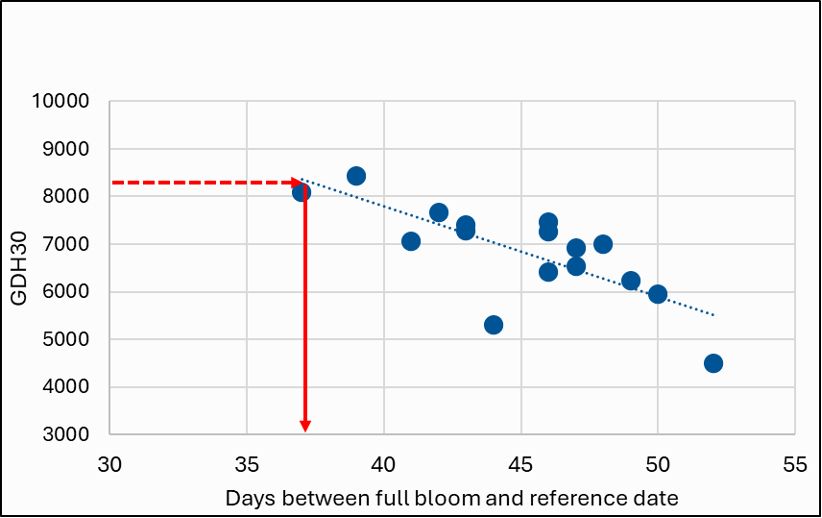
Figure 1. An example of how early heat (high GDH30) shortens fruit development. Fewer days pass from full bloom (FB) to reference date (RD) with higher GDH30. Data (2010-2025) are from Sutter County. Red line shows 2026 GDH30 and expected time from FB to RD. All GDH30 data are from Verona CIMIS station.
Leave a Reply