


Ryan Hill, UCCE Weed Science and Agronomy Advisor, Tehama, Shasta, and Glenn Counties
Overview:
Rimsulfuron (sold as Matrix, Hinge, Grapple, Revolt, and others) can be used in tank mixes to control difficult winter-annual weeds like hairy fleabane and Italian ryegrass and even suppress summer perennial weeds like johnsongrass and yellow nutsedge when applied appropriately.
Research conducted in 2025 (linked here) demonstrated suppressive effects of rimsulfuron on established johnsongrass populations when applied in early March, but little is known concerning the ideal time to deploy such an application. Several research trials were installed in 2026 to identify the best time to apply a post-emergent tank mix of glyphosate and rimsulfuron for control of established johnsongrass populations. Results suggest that early March through mid-April allowed for the greatest efficacy, with control ranging from 76 to 98% when applied with adequate rainfall for herbicide incorporation.
Applications in late January, early February, or early May were not ideal and resulted in an unimpressive ~35% boost in efficacy, relative to the control plots.
Note: the mention of products is not a pesticide recommendation, simply the sharing of research results. Products may not be registered for use in California. Consult your PCA and always read the pesticide label; the label is law.
Research methods and results:
Herbicide applications were made in 2024, 2025, and 2026 to test efficacy of a glyphosate + rimsulfuron tank mix on established johnsongrass populations. Rimsulfuron was applied as either Matrix or Revolt (4 oz/A) and glyphosate (Roundup Powermax 3) was applied at 2 pt/A as a reference treatment, or in a tank mix with the rimsulfuron product. Every treatment also included 1% ammonium sulfate at 1% v/v. Two trials (January 26th and February 6th) did not have glyphosate as a control treatment, due to no emerged weeds at time of application. All other trials used glyphosate as a reference treatment. Treatments were rain incorporated withing 2 weeks of application. Weed coverage was rated 8 weeks after each application and the improvement in control assessed as a percent reduction in weed coverage relative to the control treatment.
The results in figure 1 summarize the improvement in johnsongrass control efficacy that the addition of rimsulfuron gave to the tank mix.
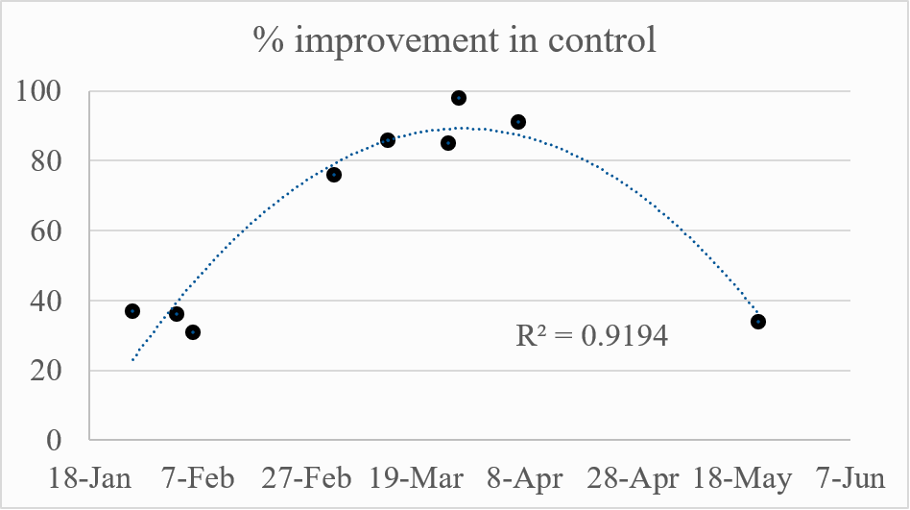
Figure 1. A tank mix of rimsulfuron and glyphosate was compared to a control treatment for nine different application dates. Percent control 8 weeks after treatment is reported for each tested application date.
One outlier was excluded from the above image. This was a late-February application performed in 2026, resulting in an 18% improvement in control from the control treatment. This application was unusual because no rainfall occurred following the application for at least a full month, unlike every other treatment.
The April 7th application (91% efficacy) has several other treatments set up for comparison, as shown in figure 2. This trial included glyphosate (Roundup PM3 [2 or 4 pt/A]), clethodim (Clethodim 2EC [8 fl oz/A]), and rimsulfuron (Revolt [4 oz/A] in different tank mixes. Rimsulfuron was not tested as a stand-alone treatment, but when tank mixed with clethodim and glyphosate the johnsongrass populations were reduced by over 90%. Clethodim alone resulted in a ~70% reduction. Glyphosate alone or mixed with clethodim did not maintain control through 8 weeks after treatment.
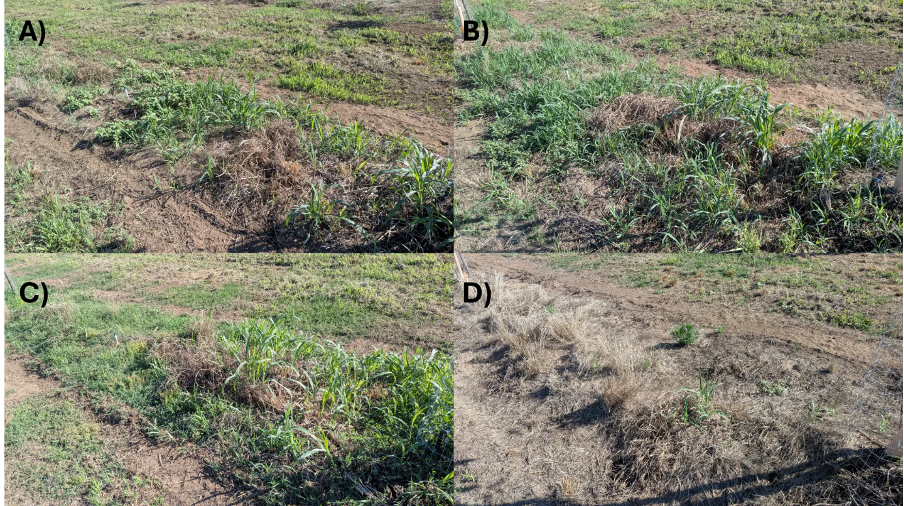
Figure 2. Post-emergent treatments were applied to an established johnsongrass population on April 7th, 2026. These images were taken on May 29th, 2026. Treatments include A) glyphosate (Roundup PM3, 2 pt/A) B) glyphosate plus clethodim (Roundup PM3, 2 pt/A; Clethodim 2EC, 8 fl oz/A) C) Clethodim (Clethodim 2ECm, 8 fl oz/A) D) glyphosate plus rimsulfuron (Roundup PM3, 2 pt/A; Revolt, 4 oz/A).
Conclusions:
Rimsulfuron is not a standalone tool for managing johnsongrass but may be incorporated into chemical rotations as a tank mix to improve either post-emergent or pre-emergent herbicide applications that target johnsongrass. If a field is heavily infested, late March or early April applications allow for improved control of johnsongrass with postemergent tank mixes with rimsulfuron. Efficacy seems to be dependent on rainfall, and the mechanism of control is likely direct uptake of rimsulfuron through the rhizomes and roots.
Less infested orchards may also benefit from rimsulfuron applications, though the importance of seedling management with herbicides like indaziflam (Alion) or pendimethalin (Prowl) increase in importance. These herbicides can have much longer residual activity than rimsulfuron, which tends to break down by 2-3 months after treatment in our climate.
For more information on this topic, you can read the article Jorge Angeles (UCCE Tulare) and I wrote for the UC Weed Science Blog linked here.
Leave a Reply