


Becky Wheeler-Dykes, Orchard Systems Farm Advisor, Glenn, Colusa and Tehama Counties
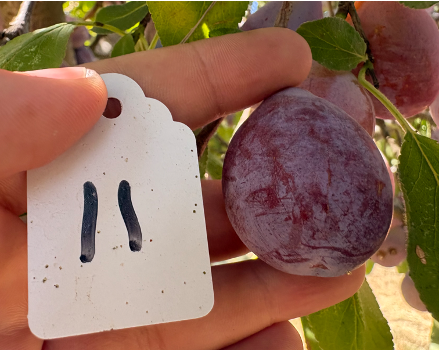
Figure 1. Individually labelled prune fruit in the sunburn study.
While the summer of 2026 felt mild and didn’t bring the days on end of over-100-degree weather we’ve seen in recent summers, many growers across the region saw devastating levels of sunburn in their prunes. Sunburn that leads to fruit drop is still something of an enigma. It’s unclear why one fruit will burn and drop while a fruit right next to it will remain perfectly healthy and make it to harvest. Sunburn is often discussed as a priority for growers who would like more management options to reduce yield losses. In response, we set up a pilot study in April measuring several characteristics of individual fruit (Figure 1) early in the season and then tracking each fruit to determine the outcome. Growers, processors, UC researchers, and farm advisors have long suspected that fruit temperature, light environment, fruit development stage, and timing of heat waves, or some combination of these factors, should explain sunburn on a fruit-by-fruit basis. Thus, fruit internal and external temperatures, light environment, and size were measured for each fruit in the study along with sensors recording temperature and humidity in the field. The following two hypotheses discussed with industry members on research tours and at the annual prune research conference appear to have the most merit based on data collected.
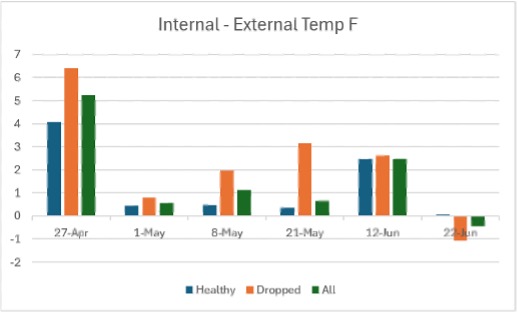
Figure 2. Graph showing large difference between internal and external temperatures of fruit that would eventually drop (orange bars).
Hypothesis 1: Fruit is less able to regulate internal temperature early in the season, before the waxy bloom on the surface of the fruit has developed. If this is true, we would expect fruit with a higher difference between internal and external temperatures to have a higher likelihood of developing sunburn and dropping later in the season. In fact, this is exactly what we saw play out. Fruit that ended up dropping later in the season had almost 4 times the temperature differential when measured in May (Figure 2). Healthy fruit that made it to harvest average 0.5F differential, while fruit that eventually dropped averaged 1.9F differential.
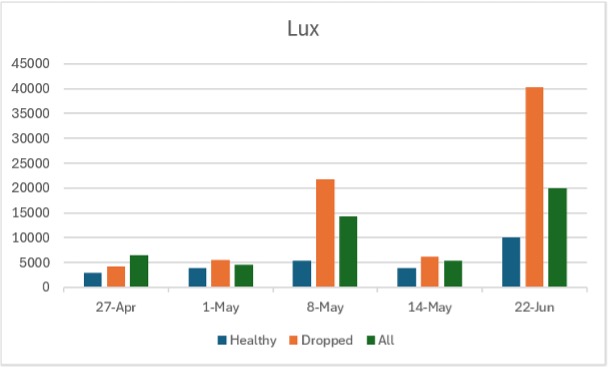
Figure 3. Graph showing that light environment of dropped fruit (orange bars) increased more throughout the season than that of healthy fruit (blue bars).
Hypothesis 2: As fruit grows and branches are weighed down through the season, fruit are exposed to more light later in the season. Since the individual fruit initially developed in a shaded environment and were not acclimated to the light environment, they are predisposed to sunburn as weighted branches increasingly bow and increasingly expose fruit to more light. This too played out in the data. The light environment of ultimately harvestable fruit increased by about 5,000Lux between May 8 and June 22 (Figure 3). Conversely, in fruit that dropped, the light environment increased by about 18,000Lux over the same period. This shows a strong correlation of fruit drop with an increase in light exposure over the season.
While the data is interesting and statistically significant, there is more work to be done. Our goal is to identify the underlying conditions leading to sunburn and, more importantly, identify tactics growers can use to keep the fruit on the trees and reduce yield loss. This pilot study indicates that multiple factors may contribute to the propensity of an individual fruit to develop sunburn. We aim to expand the study in 2027 to additional fields to collect data from individual fruit in the hopes of confidently parsing risk factors, while testing additionally evaluating mitigation strategies.
Leave a Reply