


Janine Hasey, UCCE Tree Crops Advisor Emerita, Sutter-Yuba, Colusa Counties
Luke Milliron, UCCE Orchards Advisor Butte, Glenn, Tehama Counties
Clarissa Reyes, UCCE Orchards Advisor Sutter-Yuba, Butte, Placer Counties
Greg Browne, USDA-ARS Crops Pathology and Genetics Research Unit (Retired)
Ali McClean, USDA-ARS, Crops Pathology and Genetics Research Unit, Davis
Andreas Westphal, UC Riverside, Department of Nematology
A lot of factors impact the planting decision. Once a site is selected, the three critical decisions in establishing a new walnut orchard are variety selection, rootstock selection, and tree/row spacing. The spacing should be determined after the variety and rootstock are chosen because that combination will determine the ultimate size of the tree, along with the soil type and orchard management. Rootstocks are the foundation of a walnut orchard. Selecting one that tolerates or resists site problems, while providing vigor for optimum tree performance, is key to orchard productivity, health, and longevity. As pesticide and fumigant options become more limited and restrictive, rootstocks that resist or tolerate soilborne pathogens offer a pathway to long-term management.
Commercially available Paradox clonal rootstocks include Vlach, VX211, RX1, and most recently, Grizzly. Vlach has been available since 1999 and came from a vigorous Paradox tree in Stanislaus County. Originally identified as superior seedlings from the Walnut Improvement Program’s statewide Paradox diversity trial in the 1990’s and then cloned, VX211 and RX1 were released by UC and USDA in 2007 and patented in 2010 after years of evaluation for vigor and soil pathogen resistance. Commercial nurseries developed efficient and reliable clonal propagation methods, and nursery production continues to shift from seedlings to clonal walnut rootstocks.
In 2012, an extensive team including UC, USDA-ARS, UCCE, nurseries, and growers with funding from the CA Walnut Board and Commission and USDA’s National Institute of Food and Agriculture, embarked on developing new walnut rootstocks with resistance to the major soilborne pathogens. The targeted pathogens were Agrobacterium tumefaciens (crown gall), Phytophthora spp. (Phytophthora root/crown rot), and Pratylenchus vulnus (root lesion nematode). This article provides updates focused on commercial clonal rootstocks and a summary of the completed and ongoing statewide rootstock trials with experimental clones. First however, is a summary of available seedling walnut rootstocks, although limited, that were the mainstay of the walnut industry before clones. Following are definitions to clarify the terminology used in this article.
The first definition below refers to resistance ratings to disease pathogens; the next two are in reference to rootstock nematode ratings.
Disease resistance in rootstocks refers to their ability to defend against pathogens, such as Phytophthora and the bacterium causing crown gall, through various mechanisms that reduce pathogen growth and damage.
Tolerance: Nematodes can reproduce on the rootstock, but the tree can grow and flourish despite their presence. The opposite is intolerant or sensitive.
Resistance: Nematodes are unable to reproduce on the rootstock, but tree growth may be affected unless the trees also carry some tolerance.
Seedling walnut rootstock attributes
Northern California black walnut: This was the rootstock of choice in the early walnut industry. Its main desirable attribute is having the most tolerance to salinity, compared to Paradox seedling and Paradox clonal rootstocks. Vigor of black walnut seedling rootstock is only moderate, and in UC trials, yields were always lower compared to trees on Paradox rootstocks. Traditionally Northern California black seedling rootstock was planted and grew well in deep loamy alluvial soils near rivers. Trees on Northern California black often have stunted growth when planted on more marginal soil. It has lower susceptibility to crown gall vs. seedling Paradox but is very susceptible to Phytophthora and to lesion nematode. Clonal Paradox rootstocks are recommended where any of these problems exist (Table 1). Black walnut rootstocks should be considered where there are salt problems like chloride and only where soils are loamy and well-draining.
Paradox hybrid seedling: This rootstock gained popularity in the 1950s because of its vigor and tolerance to Phytophthora and lesion nematode relative to black walnut rootstock. However, Paradox seedling rootstocks are very susceptible to crown gall disease and do not possess as much resistance as RX1 clonal rootstock to Phytophthora species. There are seed sources that have lower crown gall incidence and certain nursery practices that prevent infection by the bacterium during the seed collection phase which can alleviate crown gall from developing. However, clonal Paradox rootstocks typically have much lower crown gall infection than Paradox seedling rootstocks across numerous trials statewide and have the other specific advantages shown in Table 1. Paradox seedlings also exhibit genetic variability, so tree size differences are more common than in clonal rootstock orchards.
Commercial clonal Paradox walnut rootstock attributes update (2026)
What we now refer to as “standard clones”, i.e., Paradox rootstocks Vlach, VX211, and RX1, have been subjected to ~25 years of screening, field research trials, and observations in growers’ orchards for confidence in the attributes listed below. These three standards are comparatives for new genotypes in UC/UCCE/USDA walnut rootstock trials.
Vlach: Available since 1999, Vlach was the first clonal Paradox rootstock to be widely planted. Parentage is Northern California black (Juglans hindsii) x English walnut (Juglans regia). Trees on Vlach typically have high growth rates and yields in trials. Although it usually develops much lower crown gall incidence than seedling Paradox, Vlach consistently developed higher incidence of crown gall and larger galls, compared to the other standard clonal rootstocks discussed here. Vlach is susceptible and sensitive to root lesion nematode and is more susceptible to Phytophthora species than the other standard clones.
VX211: Parentage of VX211 is Northern California black x English walnut. Trees on VX211 typically have high growth rates and yields in trials. Its main attribute of rootstock interest is its tolerance to root lesion nematode. The nematode reproduces on this rootstock, but in most instances, VX211 can tolerate higher levels of it than the other standard rootstocks. It is recommended for where there are nematode problems or as replant trees in existing orchards because of the root lesion nematode tolerance advantage paired with vigor. However, VX211 can be damaged by root-knot nematode, a group that is rarely encountered in walnut growing areas. VX211 has notably less crown gall than seedling Paradox and consistently less crown gall than Vlach in field trials. It is more resistant than Vlach but less resistant than RX1 to Phytophthora. You can find more replant considerations at: sacvalleyorchards.com/walnuts/cost-and-expense-considerations/replanting
RX1: The genetics for RX1 are different than for Vlach or VX211. RX1 parentage is Texas black (Juglans microcarpa) x English walnut. The J. microcarpa seems to instill resistance to Phytophthora and potentially to crown gall disease and therefore has been used extensively to breed the new rootstock genotypes we’re testing and reporting on in statewide field trials. As a rootstock, it has moderate vigor, but grafted trees on RX1 often have equal or more vigor compared to trees on VX211, and they yield well at most sites.
RX1 has moderate to high resistance to Phytophthora, depending on the pathogen species (Table 1), making it the preferred rootstock for any site with Phytophthora. Consistent in our greenhouse screening and often in statewide field trials, RX1 has the least crown gall of the three standard clones. RX1 may handle drier conditions in terms of irrigation scheduling and still be vigorous and productive but this needs further research. RX1 appears to show lower salinity tolerance (leaf scorch) than the other standard clonal rootstocks. Consider using a different rootstock in situations with soil or water salinity concerns.
Vlach, VX211, RX1 disease rating: The updated problem situation table below reflects results of newly completed statewide rootstock research trials. None of these three clonal rootstocks have high resistance to A. tumefaciens (cause of crown gall). In two studies, potted trees on RX1 rootstock were compared to field grown one-year-old bare root June budded trees on RX1 for crown gall infection. After seven years, potted trees that had been grown in sterile media before planting in the orchard had zero to very low crown gall incidence whereas the field grown June buds had a higher incidence. Perhaps delayed exposure to A. tumefaciens in potted trees resulted in the lower crown gall infection.
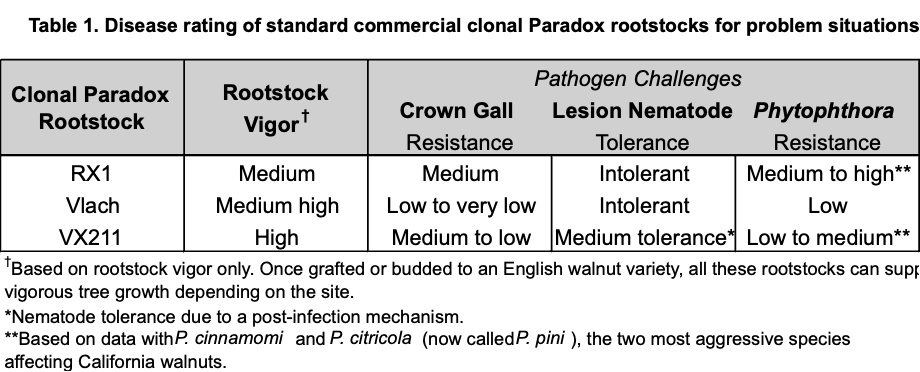
Table 1. Disease rating of standard commercial clonal Paradox rootstocks for problem situations
Grizzly: The most recent commercially available clonal Paradox rootstock, Grizzly is patented by a grower and a nurseryman. Grizzly parentage is Northern California black x English walnut. It was propagated from a mother tree in a second-generation commercial orchard planting with very sandy soil and lesion nematodes. Over 20 years, this tree had twice the size and production of surrounding trees that declined much earlier. There was one replicated trial in Lake County planted in 2016 and another planted in Sutter County in 2022 on Grizzly rootstock, but there is currently insufficient trial data to assign crown gall and Phytophthora resistance ratings for Grizzly. In 4 to 6-year-old orchards with Grizzly rootstock and on some older trees, crown gall has only been seen on a handful of trees to date.
Grizzly is highly susceptible to root lesion and root-knot nematodes but appears to have high levels of tolerance. This means that trees on Grizzly can grow well even though nematodes reproduce heavily on its roots. Trees on Grizzly have demonstrated vigor in difficult growing conditions. Grizzly rootstock is often planted in orchards with tougher, coarse soil or for replant situations.
Clonal walnut rootstock field trials
Since 2015, several replicated rootstock trials statewide have compared new experimental rootstocks to the standard clonal walnut rootstocks (RX1, Vlach, VX211) with differing soil and disease challenges. They are listed in Table 2 below and this article summarizes the most important results of the completed trials. For detailed data and results, refer to Pacific Nut Producer, December 2025, Volume 31/No.12, pp. 6-12 https://pacificnutproducer.com/2025/12/01/read-december-2025-issue/#read-december-2025-issue/6/
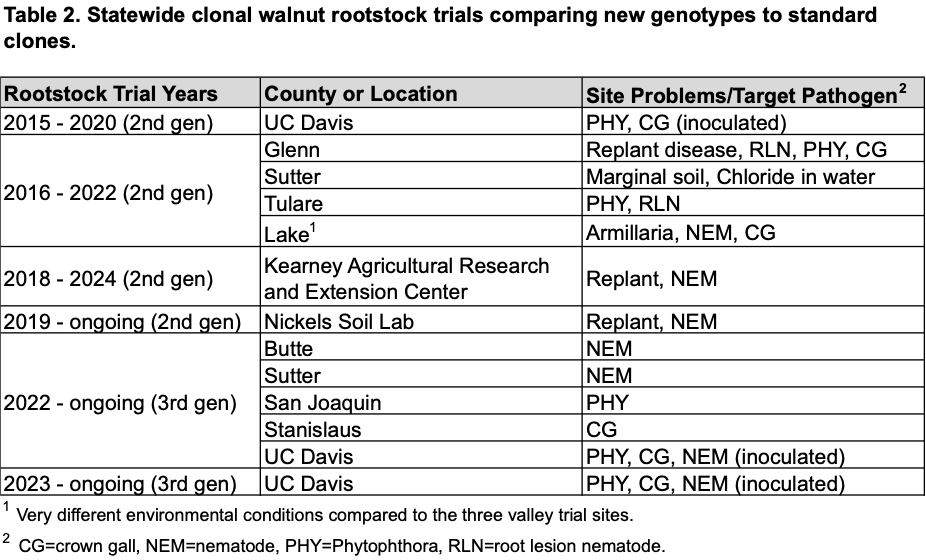
Table 2. Statwewide clonal walnut rootstock trials comparing new genotypes to standard clones
2015-2020 trial at UC Davis: Four new 2nd generation clonal rootstocks include: K3 (J. microcarpa) and 11-991 (J. microcarpa × J. regia), with supposed resistance to crown gall (A. tumefaciens), and STJM4 and 29JM 8 (both J. microcarpa × J. regia), with supposed resistance to Phytophthora spp. Potted clonal trees of these new genotypes and standard clones VX211, RX1, and Vlach were planted spring 2015 and patch-budded to Chandler in September. In May 2017, trees were inoculated with either Phytophthora cinnamomi and Phytophthora citricola or A. tumefaciens. In fall 2020, crown gall incidence and gall size were rated and excavated root systems sampled to assess crown and root rot incidence.
For Phytophthora crown rot, there was no incidence in RX1 and 11-991, confirming our ratings in Table 1 for RX1 and resistance to Phytophthora and in some of the new genotypes. For crown gall, experimental rootstocks K3 and 29JM 8 developed minimal disease symptoms. Crown gall symptoms on RX1 were intermediate between symptoms observed on rootstocks K3 and 29JM 8 and other industry standards Vlach and VX211. All four of the new genotypes had less crown gall severity than both Vlach and VX211, suggesting some resistance to A. tumefaciens.
2016-2022 trials: The four new genotypes listed above along with standard clones and seedling Paradox rootstocks were compared for survival, growth, yield, nut quality, sucker counts, and crown gall incidence in four counties (Table 2). The sites were not fumigated prior to planting. One-year-old Chandler June budded trees on the eight rootstocks were planted in winter or spring 2016 and left unheaded. We concluded the trials after the 2022 season although some data collection continued at two locations.
Rootstock performance varied by location. Standard clonal rootstocks VX211, RX1, and Vlach continued to perform well overall having no (VX211) to very low (RX1 and Vlach) mortality and good trunk growth in the valley sites.
Trunk growth: The clonal standards and experimental K3 had the same trunk growth in Sutter and Glenn Counties; in Tulare County, all new genotypes had the same trunk growth as VX211. Tree trunks on K3 tended to lean in the early years only in Sutter (see Figure 1) and Glenn Counties but many trunks straightened with maturity. Suckers were observed on K3 in Tulare County, whereas in Lake County most suckers were found on RX1 followed by K3. Sucker growth was not a problem in Glenn or Sutter Counties.
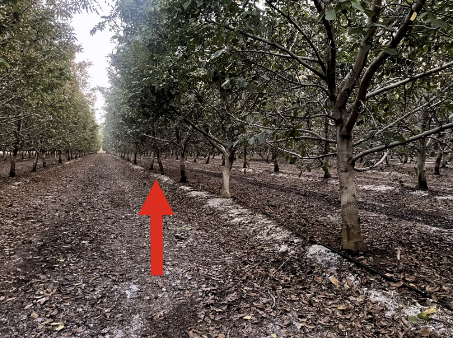
Figure 1. In Sutter Co. trial above (fall 2024), note trees 4 and 5 with a slight lean on K3 (see arrow). Tree trunks in foreground are straight. (Photo credit: Clarissa Reyes)
Yield: Cumulative yields varied between the four trial sites. Only the Tulare trial had no significant yield differences between rootstocks. Chandler on Vlach yielded well at each trial site, and trees on RX1 yielded well at the valley trial sites while nut yields on seedling Paradox had the lowest yields at Glenn and Sutter locations. Chandler yields on the new genotype K3 were also good, being equivalent to those on VX211 at the valley sites and were also not significantly different from yields on RX1 and Vlach at Glenn and Sutter locations.
Crown Gall: In annual crown gall surveys from 2018 through 2022, crown gall incidence below the graft union was only reported in the first year observed. Across all trial locations, clonal Paradox rootstocks had substantially lower crown gall incidence at ground level compared to the highly susceptible seedling Paradox rootstock (Figure 1). Paradox seedling crown gall incidence ranged from 43% (Lake Co.) to 95% (Sutter Co.). The new genotypes had much lower or no (11-991) crown gall incidence compared to the standard clones. Vlach had the most crown gall of the standard clones consistent with other statewide long-term rootstock field trials (Figure 2).
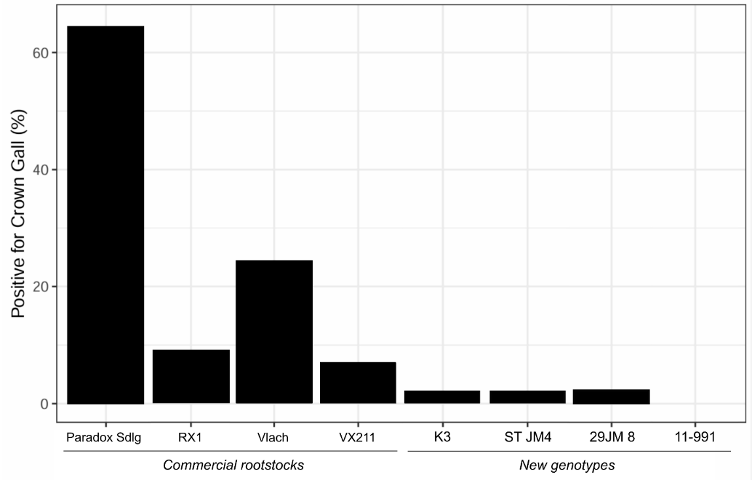
Figure 2. Cumulative crown gall (%) at ground level combined from all trial locations
Crown galls at ground level appeared early on young Paradox seedling rooted trees. Conversely crown gall generally first appeared on older trees on RX1, Vlach, and the new genotypes. Ground level incidence of crown gall significantly reduced Chandler trunk growth on Paradox seedling. The rapid onset of crown gall in the first three survey years compared to that on the clonal rootstocks contributed to this reduction in Paradox seedling trunk growth. Previous research shows it is critical to reduce crown gall disease in the first four years of an orchard to avoid severe tree stunting and cumulative yield losses.
2018/2019 trials: 2nd generation experimental clonal rootstocks were compared to standard clones for nematode resistance and tolerance. Experimental K3 appears to have moderate resistance and moderate levels of tolerance to root lesion nematode, meaning trees grow well even though nematodes are present in the soil. It also appears to handle the replant problem – caused by an undescribed microbial complex – better than the three standard clonal rootstocks.
2022/2023 – Current trials: There are over 20 new 3rd generation rootstock genotypes being tested in four locations against the target pathogens (Table 2). The UC Davis trials have been inoculated with these three soilborne pathogens and are measured for growth and survival only (Table 2). Results will be shared in the next couple of years.
Looking for grower cooperators
Rootstock development is a long-term investment. The many experimental rootstocks identified that appear to cope effectively with soil-borne diseases need more field testing to confirm their usefulness. From our trials on 2nd generation experimental genotypes, K3 emerged as a rootstock in the valley trials that merits further testing in grower orchards. Compared to the standard clonal rootstocks, it had equivalent yields and growth, lower and delayed crown gall infection, and showed superior growth under non-fumigated nematode-infested replant conditions. K3 has not exhibited as much resistance to Phytophthora species as RX1. Other concerns noted at two trial sites include its propensity for some trees to lean, especially in early years, and for potential suckering. We are especially interested in testing experimental K3 in orchards with replant situations, non-fumigated borders, sandy soil, or any other situation in which we expect nematode or crown gall pressure to be high. Growers interested in obtaining trees should contact your local UC Cooperative Extension Farm Advisor who will facilitate this process.
Acknowledgements: Contributing authors to the 2015 and 2016 research trials include Katherine Jarvis-Shean, Elizabeth Fichtner, Rachel Elkins, Chuck Leslie, Bruce Lampinen, Jerome Braun, Danielle Lightle, and Dan Kluepfel.
Leave a Reply