


Luke Milliron, UCCE Orchard Advisor Butte, Glenn, Tehama;
Becky Wheeler-Dykes, UCCE Orchard Advisor Glenn, Tehama, Colusa;
Jaime Ott, UCCE Orchard Advisor Tehama, Butte, Glenn, Shasta;
Franz Niederholzer, UCCE Colusa, Sutter-Yuba
Back on August 6 in Orland we had a UCCE advisor panel discussing six things that kill prune trees. If you missed that meeting or attended but wanted more resources, we’ve got you covered. We have links to everything discussed as well as the meeting slides.
Keeping trees alive is the core to orchard longevity and maximum grower profitability. Cytospora canker, bacterial canker, prune brownline, phytophthora, Phellinus wood rot, and gophers are top culprits for killing prune trees and shortening orchard economic longevity. Back on August 6, 2025 in Orland we discussed each of these important prune tree killers. If you missed that meeting or attended but wanted more resources, we’ve got you covered. We have the meeting slides as well as links on where to learn more.
Cytospora canker: This fungal canker is a threat every year and has shortened the life of countless prune orchards. This disease can be differentiated from bacterial canker by cutting into and more closely examining the canker (Figure 1). Cytospora enters prune trees through damaged tissue (sunburn, pruning wounds, etc.) and spreads rapidly in weak trees. Maintaining healthy, well managed trees is a key component in limiting the canker. So, this disease requires attention to year-round management through both cultural and chemical means. Learn the critical components to combating this disease via article or podcast. You can also find the relevant presentation slides 5-11 below.
Bacterial canker: Due to its links to specific weather and orchard characteristics, this is thankfully not an every year disease. However, that is little consolation to growers who suffer from this disease. During the pre-plant period, rootstock selection, soil preparation, and fumigation are all helpful. Ring nematode management is critical although potentially insufficient on its own in preventing bacterial canker. After planting your orchard your options are limited to reducing tree stress and employing fall nitrogen applications. Once again you can learn more either via article, podcast, as well as from slides 11-15.
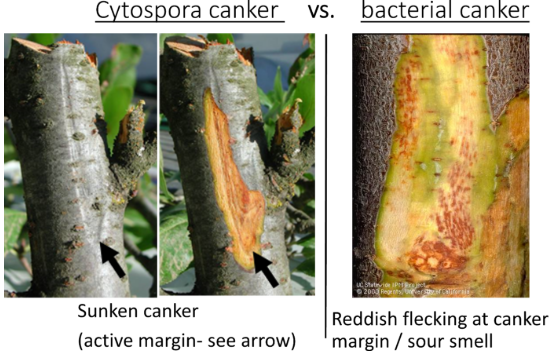
Figure 1. This disease can be differentiated from bacterial canker by cutting into and more closely examining the canker. Especially compare the distinct zonate (bathtub ring) margin of the Cytospora canker to the indistinct reddish flecking and sour sap smell of bacterial canker. Your local orchard farm advisor can also help with diagnosis. Photos by Franz Niederholzer (L) and UC IPM (R).
Prune brownline: Since the spring of 2023 this newly rediscovered disease has killed trees in multiple north Sacramento Valley orchards. To distinguish between brownline, phytophthora, or another culprit you will need to cut into the base of the trunk of trees with uniformly collapsing canopies (figure 2). If the whole canopy is “going down” look to the trunk or roots! This nematode vectored viral disease is best managed through rootstock selection, currently most rootstocks are known to be susceptible including Krymsk 86, Marianna 2624 is resistant, and Marianna 40 is being tested for resistance. Once again you can learn more about this disease from an article, a podcast, or on slides 17-29.
Phytophthora: With most prune orchards being planted on plum or part plum rootstocks, phytophthora root and crown rot is less of a concern than in many other crops including almonds and walnuts. However, Jaime Ott did confirm Phytophthora in a north state prune orchard in 2025. Trees are infected by the so called “water mold” under saturated soil conditions. Therefore, irrigation management is phytophthora management: keep water away from the crown. Rootstocks once again are key, with M2624 and 29C being resistant, Krymsk 86 somewhat resistant, and peach based rootstocks being susceptible. You can learn more at UC IPM, podcast, and in slides 17-21, 30-34.
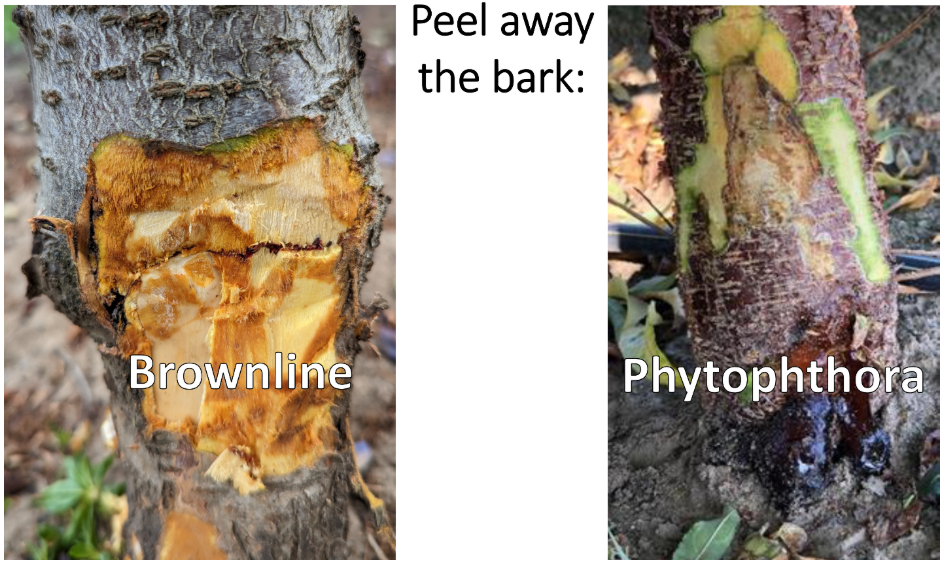
Figure 2. A tree with the full canopy in decline tells you that the problem originates from the trunk or roots. Cutting in with a knife or hatchet is a great next step in diagnosis. For prune brownline (left) a thin dead zone of tissue can be found between rootstock and scion. For phytophthora a canker often with associated gumming originates from below ground, although lab diagnosis may still be needed for confirmation. Photos by Jaime Ott.
Phellinus wood rot: Do some of your trees “blow up” at harvest, as in have entire scaffolds break off when they encounter harvest machinery? Upon inspection if the middle of that broken scaffold is as soft as balsa wood, you likely have phellinus wood rot destroying your trees from the inside out (figure 3). In a recent study 34% of surveyed trees in the Sacramento Valley were found to have the disease! With 93% of these infections being traced back to pruning wounds, the only current management approach is to prune soon after harvest (i.e. avoid pruning mid-January – March, depending on location in the Sacramento Valley). You can lean more via article, podcast, and in slides 35-41.
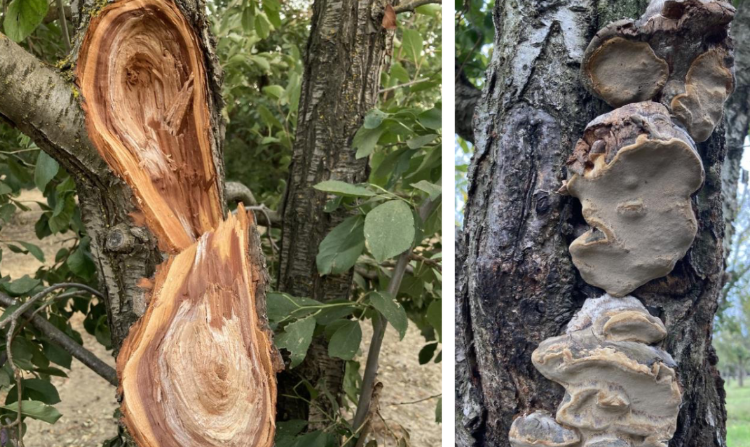
Figure 3. Phellinus wood rot is a fungal disease that destroys the structural integrity of prune trees by destroying them from the inside. The disease has fruiting bodies called conks (R) that perpetuate the disease. Photos by Laurel Hoffman.
Gophers: Since 2024, we’ve been dealing with a massive uptick in gopher damage in Sacramento Valley orchards. Gophers often inflict their damage by girdling the tree just below ground (figure 4, C). With damage occurring to the roots/trunk we once again have damage that results in a uniformly crappy looking tree canopy (see slides 18-20). You will usually have to dig around the trunk base to diagnose the problem. Trapping, bait, fumigation, birds of prey, and flood, are the main controls for this year-round nemesis. You can learn more via article, podcast, and at slides 42-48.
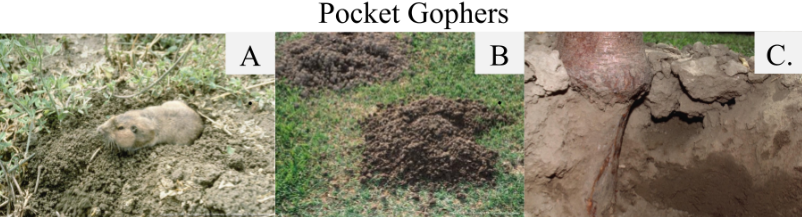
Figure 4. A-C. Identification of pocket gophers (A), their mound type (B), and example of damage (C). Photos by Jack Kelly Clark (UC IPM).
Still have questions about a prune tree killer? Get in contact with your local farm advisor. Also be sure to subscribe to Sacramento Valley Orchard Source so you don’t miss out on future events like this!
Prune Tree Killers PowerPoint Slides 1 – 26
Prune Tree Killers PowerPoint Slides 27 – 50
Many thanks to the California Prune Board who funded much of the research presented and provided the delicious lunch at the August 6 meeting.
Leave a Reply