


Clarissa Reyes, Orchard Systems Advisor, Sutter-Yuba, Butte & Placer counties
Roger Baldwin, Professor of Cooperative Extension, University of California, Davis
I’ve received multiple farm calls regarding extreme ground squirrel infestations in orchards over the past two years. Potential reasons for high ground squirrel populations are an increase in abandoned orchards with no pest control, increased restrictions on tools for ground squirrel control, and an increase in vegetative food sources for rodents after a period of drought. Problems in nut orchards include damage to nuts, tree bark, trunks, scaffold limbs, and underground root systems, chewed irrigation lines, and in the most extreme case I saw this summer, complete crop loss. It can be difficult to control squirrel populations mid-season, when there are lots of nuts as a food source and when some squirrels may be estivating (hibernating due to summer heat), but now that those nuts are out of the picture, here are some post-harvest and dormant season management practices that may help knock squirrels back before next year.
Post-Harvest: Bait with zinc phosphide-treated grain (2.0%)
- • Zinc phosphide bait consists of toxin-treated grain and can be a cost-effective method for controlling ground squirrels, especially when populations are high. To be effective, bait must be used at a time of year when ground squirrels are feeding on seeds and will readily accept baits.
- • Zinc phosphide is an acute toxin and kills ground squirrels after a single feeding, so it can reduce numbers more quickly than anticoagulant rodenticides, which require multiple feedings.
- • Zinc phosphide is applied via broadcast application or spot treatment. It is not generally allowed for use in bait stations, although this may change in the future.
- • This bait has a distinctive odor and taste, so squirrels can eat a little and get sick, but not die, and then learn that the bait is bad (become “bait shy”).
- • If you want to improve chances that they will eat the zinc phosphide bait, you can pre-bait the area. Before broadcasting or spot treating with treated bait, you should prebait with untreated grain 2-3 days prior to the application of zinc phosphide. Check for bait consumption a few days later. If they are taking the pre-bait, apply the zinc phosphide per label specifications. If pre-bait is not readily consumed, a zinc phosphide application is not likely to be effective.
- • Most squirrels will die underground and not be visible. Additionally, zinc phosphide has very low to almost no secondary exposure risk to predators or scavengers, making it safer for use than anticoagulant rodenticides from this perspective.
- • However, zinc phosphide is acutely toxic and has no antidote. As such, it poses a greater risk of primary exposure to nontarget species than do anticoagulant rodenticides.
Late winter/early spring: Fumigation
- • You can fumigate with gas cartridges, aluminum phosphide tablets/pellets, pressurized exhaust machines, and carbon dioxide injection devices.
- • Aluminum phosphide is often cheaper, but a restricted materials permit is required for using aluminum phosphide.
- • If using aluminum phosphide, place the tablets deep into the burrow and then cover the opening with newspaper or some other material before covering the entrance with loose soil. The newspaper acts as a barrier to keep the tablets from getting buried by the soil. If buried, the gas will not evolve from the tablets at a fast enough rate to be effective.
- • Gas cartridges should be lit and inserted into the burrow. All openings where smoke is detected should be buried with loose soil to hold the gases in.
- • Pressurized exhaust machines and carbon dioxide injection devices use a probe to inject the compressed gas into the burrow entrance. Be sure to treat all active burrow entrances unless you know they are connected to another entrance that you are treating. Burrow entrances should be closed while you are injecting carbon dioxide or pressurized exhaust into them.
- • Fumigation should happen in early spring (after bloom for almond) when soil moisture is high. This is very important; sufficient soil moisture is required to maximize effectiveness of burrow fumigants, and most do not work in dry soil. For best control, use burrow fumigation about 2-3 weeks after the first ground squirrels emerge from hibernation.
- • Do not treat inactive burrow systems.
- • After the initial fumigation, recheck burrows and re-fumigate any that have been re-opened.
Next season: Bait stations with anticoagulant bait (e.g., diphacinone or chlorophacinone 0.005%)
- • Bait stations can be effective when squirrels still have limited food availability during late spring/early summer, when there is less green vegetation to feed on, but nut crops have yet to set.
- • Place bait stations near runways or burrows and secure them so they cannot be tipped over. If ground squirrels are moving into the crop field from adjacent areas, place bait stations along the perimeter of the field where ground squirrels are invading, one station every 20 to 100 feet depending on ground squirrel density in each area.
- • Successful baiting via bait stations usually requires 2 – 4 weeks. Anticoagulant rodenticides are chronic-feed materials, meaning they generally need to be consumed over the course of several days to get a lethal dose. As such, you need to regularly check bait stations to make sure they maintain a constant bait supply. If bait goes missing after only a day or two, more bait stations may be needed.
Notes on zinc phosphide, aluminum phosphide, and anticoagulants: These are restricted chemicals and need to be on a grower’s pesticide use permit to use them. They can be added to a grower’s private applicator card or a state issued applicator license via your County Ag Commissioner, who will then send the updated permit to the grower or chemical dealer via email.
Also, the mention of products is not a pesticide recommendation, simply the sharing of research results. Consult your PCA and always read the pesticide label; the label is law.
What about trapping?
- • Can be effective as a follow up approach to other tools, but is not generally the primary tool for ground squirrel control unless the population size is small or if you are an organic producer.
- • Can use kill traps or live traps. Examples of kill traps include body gripping traps, tube traps, and automatic repeating traps. Examples of live traps include single and multi-catch cage-style traps.
- • Traps must be checked daily. If using live traps, ground squirrels must be euthanized humanely either via shooting in the head or using a carbon dioxide euthanasia chamber.
- • Pre-baiting traps (a period where bait is placed in traps but the traps aren’t activated) can increase the effectiveness of a trapping program. Keep pre-baiting until the bait is removed from all or almost all the traps on a regular basis. When that occurs, it is time to set the traps.
- • Trapping always takes more traps than you think. Many traps are needed for a trapping program to be successful, but the general number of traps will vary depending on the density of ground squirrels in an orchard.
Additional resources on ground squirrel management: groundsquirrelbmp.com
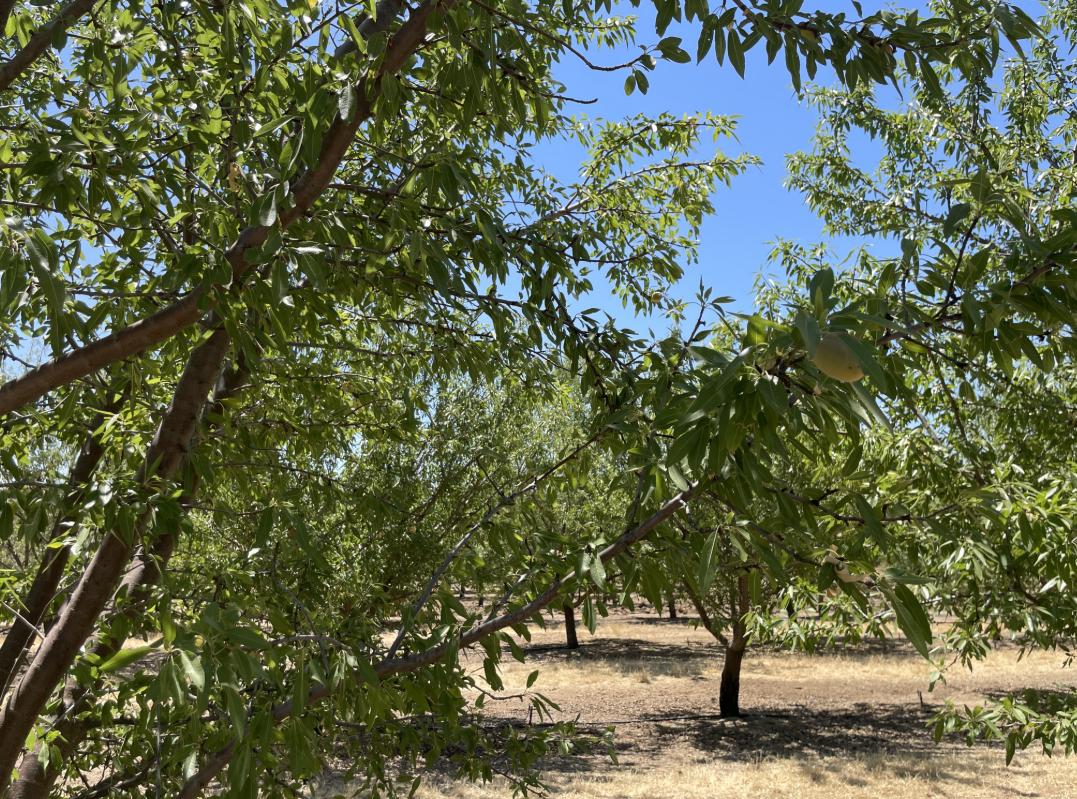
Only one nut left on this almond tree – complete crop loss from ground squirrels by July. (Photo: C. Reyes)
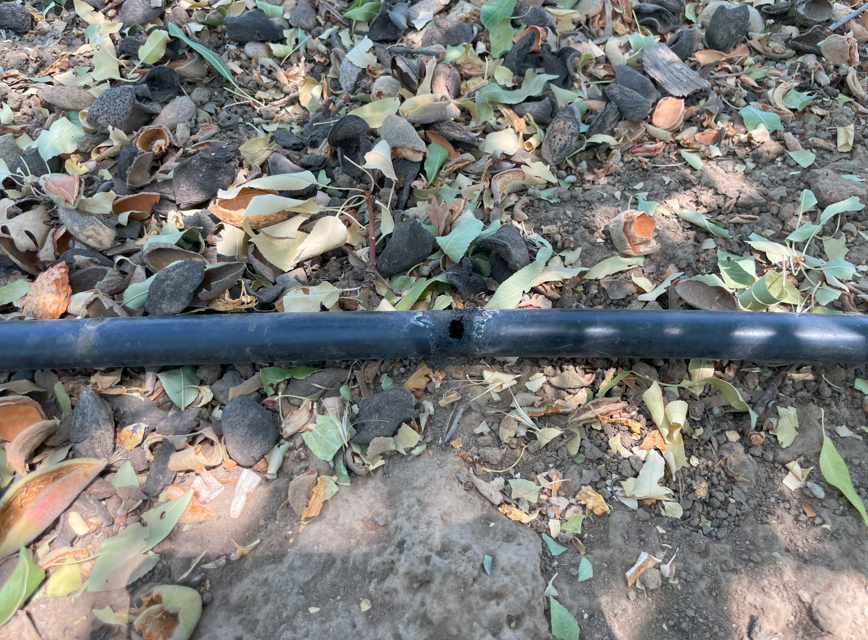
Irrigation dripline damaged by ground squirrels. (Photo: C. Reyes)
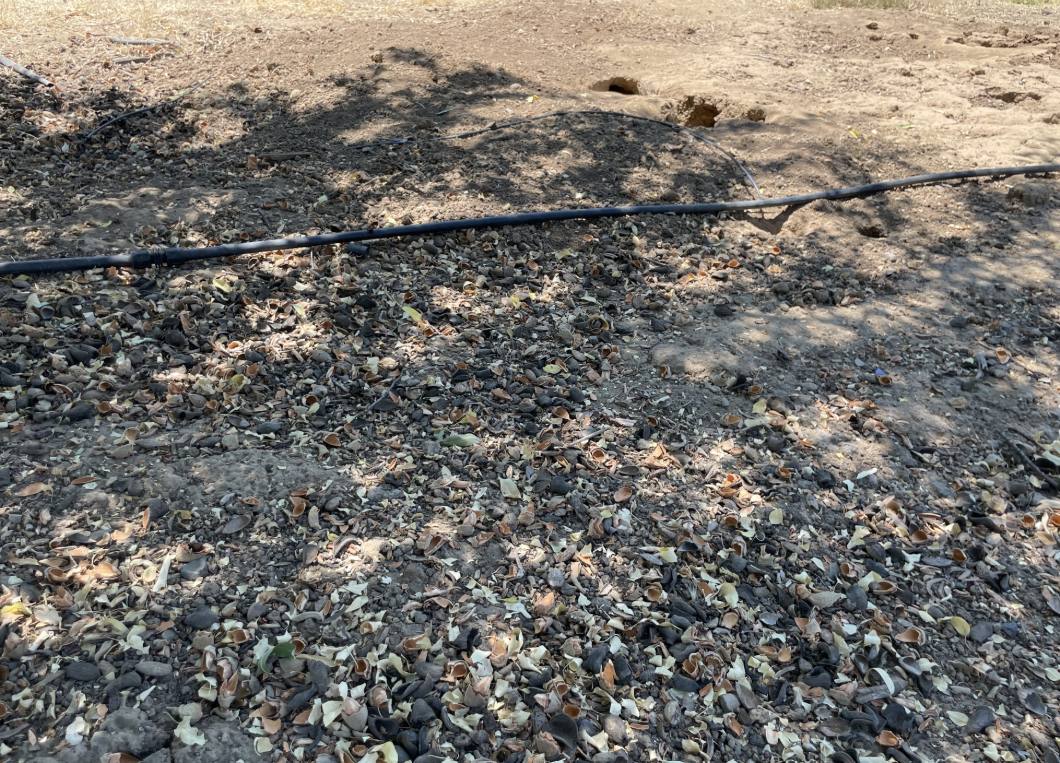
Ground squirrel burrows in background, almond shells on ground as evidence of crop loss in foreground. (Photo: C. Reyes)
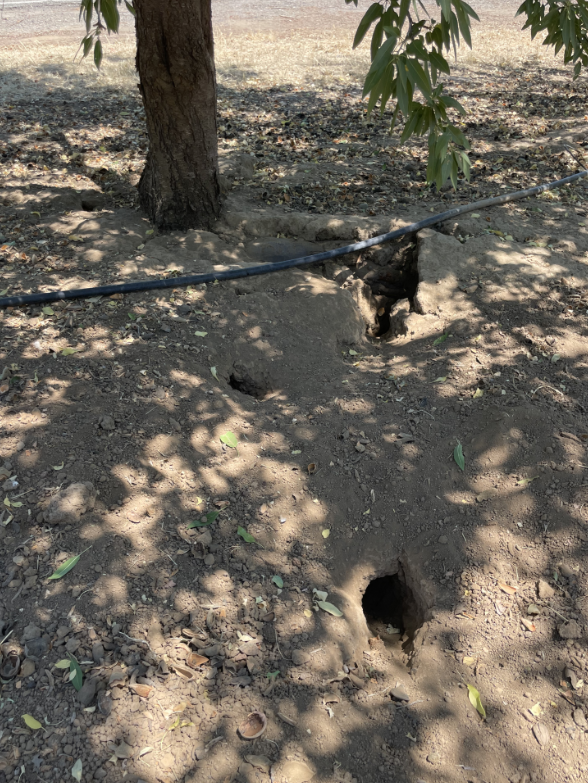
Ground squirrel burrows (Photo: C. Reyes)
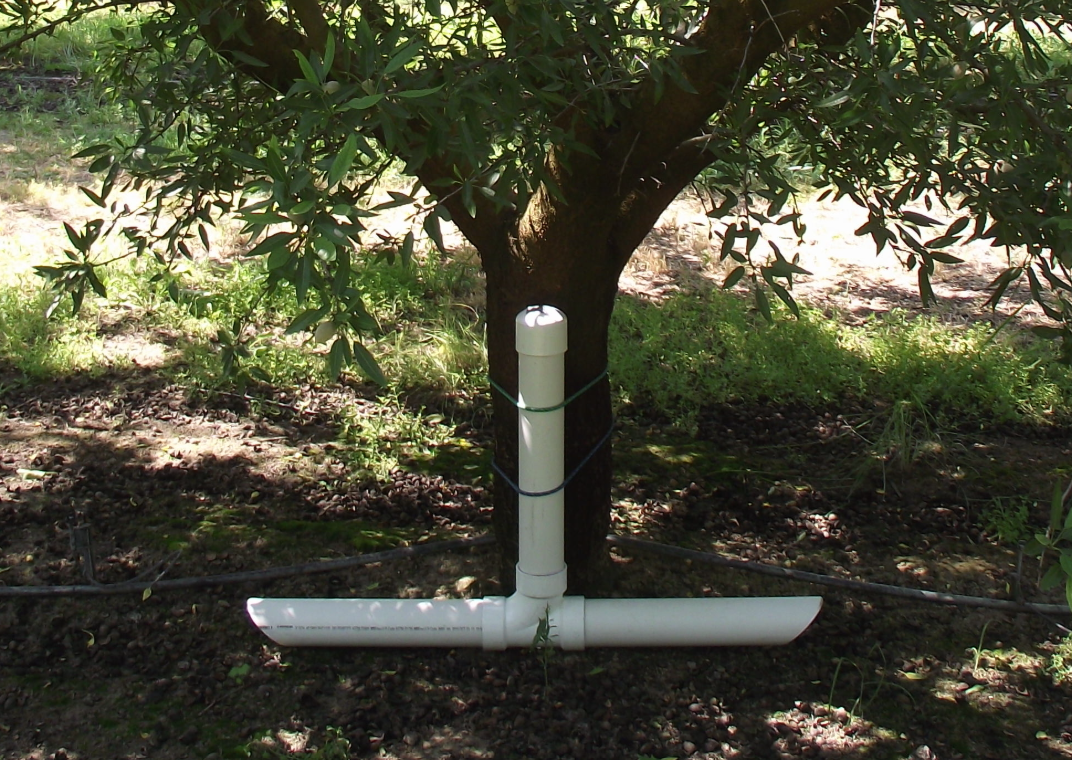
Ground squirrel bait station (Photo: R. Baldwin)
Leave a Reply