


Ryan Hill, UCCE Agronomy and Weed Science Advisor, Tehama County
Overview
The 2025 walnut pre-emergent herbicide demonstration trial is completed, and the results show strengths and weaknesses of 19 different herbicide treatments, applied either in February or March.
Takeaways:
- All treatments were applied with a strong post-emergent mix, but hairy fleabane and white clover were not adequately controlled with post-emergent treatments alone. Control was dependent on the addition of an ALS inhibitor herbicide (products like Craze, Matrix, or Mission).
- Summer annual weeds were best controlled by products with long residuals (products like Alion, Chateau, Brake On! (not registered in CA), and Prowl.
- Yellow nutsedge was controlled by treatments with Zeus or Craze.
- Conclusion: Pre-emergent treatments in late winter must account for winter annual weeds that have already emerged and perennial weeds while also maintaining good residual control further into the summer.
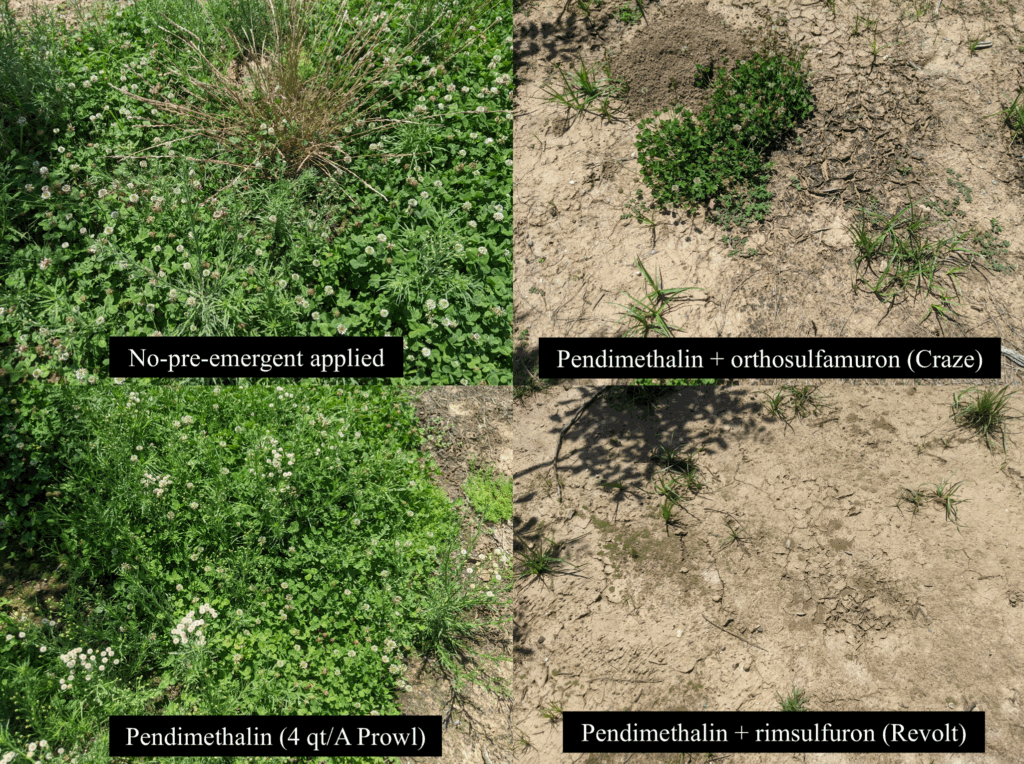
Prowl (pendimethalin) was ineffective at controlling fleabane and white clover on its own, as these weeds had already emerged by the time of application. While every plot received a post-emergent clean up mix (Roundup and Rely), the addition of Prowl resulted only in a 10 % reduction in fleabane coverage relative to the post-emergent-only control. The addition of Craze or Revolt to the tank mix radically improved overall control.
Introduction
Winter pre-emergent herbicide applications are critical to get right if yearly weed management operations are going to be successful in walnut orchards. Poor selection of herbicides or missed timing could make the difference between good control and battling an overwhelming infestation of weeds. In walnut orchards I have regularly heard two comments concerning pre-emergent herbicide applications in walnut orchards:
- Those who apply pre-emergent herbicides in the fall, just after harvest, tend to have the cleanest orchards.
- February or March are the most common times to apply pre-emergent herbicides in walnut orchards.
Maybe my perception is incorrect, but these weed control strategies seem to be at odds. When it comes to winter annual weeds, it is likely safest to apply pre-emergent herbicides before germination due to several common weed species with herbicide resistance issues (hairy fleabane, Italian ryegrass, annual bluegrass). Applications later in the winter will have to deal with emerged weeds, potentially resulting in more escapes and misses.
However, herbicide treatments in February or March are common, and many growers have been successful with these treatments. Why is this, and what is the key to achieving good control later in the winter? Success at later timings depends on how much post-emergent activity you are getting out of your tank mix. Some pre-emergent herbicides can contribute to your post-emergent activity. Common pre-emergent herbicides like Goal, Chateau, Matrix, Pindar, and others add some extra post-emergent activity to tank mixes when used in winter months. Dr. Brad Hanson (UCCE Weed Specialist at UC Davis) discussed this topic when he addressed tank mixes of Alion and Matrix in his UC Weed Science Blog article (linked here). My recent work with rimsulfuron on established johnsongrass also explored this subject (linked here). These prior discussions focused on rimsulfuron products as tank mix partners for pre-emergent applications, but I wanted test a broader range of products applied in February and March. This year’s walnut preemergent herbicide demonstration made some progress toward that goal.
I will discuss my findings next, and at the end of this article I have included results tables. All products except one are currently labeled for use in walnut orchards, though with some restrictions on orchard age. The one unlabeled product in this study was Brake On!, manufactured by SePRO, currently pending registration in CA. This is not an exhaustive list, and the data provided here does not constitute a recommendation of any product.
Trial design
In 2025, I arranged my pre-emergent demonstration trial to evaluate individual products and tank mixes for weed control efficacy when applied in February and March. This trial was installed in the Loybas Hill region of Tehama County, in a 4-year-old walnut orchard with Tehama silt loam soil. A post-emergent mix of 2 qt/A Roundup Powermax 3 and 2 qt/A Rely 280 was added to every plot in February, and pre-emergent herbicides were applied either in the mix, or one month later in March. The tables at the end of this article show the full list of treatments and when they were applied. The first table represents weeds that were present at application, hairy fleabane and white clover. The second represents weeds that grew to be prominent in May and June, so their control depended on residual activity from my herbicide treatments lasting long into the summer.
Results overview
White Clover and Hairy Fleabane (Table 1): Both weeds were controlled by all three group 2 herbicides tested: Craze, Revolt, and Mission. Revolt was weaker on fleabane while Craze was weaker on clover and these differences also showed up in the tank mix treatments with both products applied with Prowl. February and March treatments with these three herbicides produced very similar results. The 12 fl oz/A rate of Chateau also effectively suppressed both species.
Summer annual weeds (Table 2): The primary weeds in the categories recorded here were grass weeds (jungle rice and large crabgrass) and broadleaf weeds (prostrate knotweed, spurge, and pigweed). Many herbicides provided good control until June (3-4 months after treatment) but only Alion, Brake on! (not currently labeled for CA), and March-applied Mission maintained “good” control of broadleaves through July. Only Alion and Prowl maintained “good” control of grasses through July.
Yellow Nutsedge (YNS; Table 2): Zeus was the best tested product for nutsedge control, but Craze also showed some effects in July by keeping nutsedge coverage low. Rimsulfuron products like Matrix and Revolt are also labeled for YNS control, but labels suggest sequential applications, and the application timings used in this trial may not have been ideal to target YNS with this product.
Summary and cautions:
This is a single trial only representing one weed population and one soil type, so results may vary by location. However, hopefully this demonstrates the importance of tank mixing to control emerged weeds as well as future emergence.
Group 2 herbicides like Revolt, Mission, and Craze can provide good post-emergent control in addition to their pre-emergent activity. But be cautious, this herbicide group is notorious for herbicide resistance. Do not overuse this class of herbicides or you will likely start seeing weeds escaping your treatments.
Look through the following tables if you are interested in seeing more information on efficacy in these trials. To see weed coverage data, view the report on the UCCE Tehama website here.
Thanks to the California Walnut Commission for supporting this work.
For any questions or additional information, contact Ryan Hill at 530-527-3101 or rjahill@ucanr.edu
Weed control tables:
Control was determined by calculating % reduction in weed coverage, relative to the plot with the worst infestation. Control is summarized by four categories. These categories may not represent each grower’s threshold of tolerance for weed control, but they can still provide relative comparisons between the products tested.
Poor control is indicated by a “p”, representing control between 0 and 50%.
Moderate control is indicted by an “m”, representing control between 50 and 70%.
Good control is indicated by a “g” and highlighted light green, representing control between 70 and 90%.
Excellent control is indicated by an “e” and highlighted dark green, representing control between 90 and 100%.
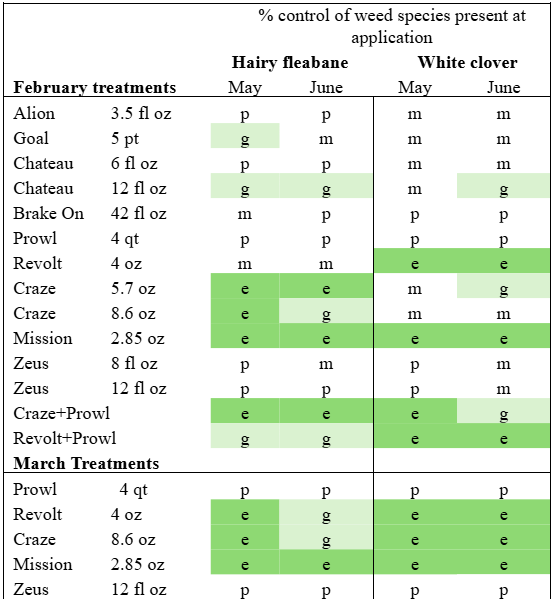
Table 1: The effect of different pre-emergent herbicides on two weeds that were present at application, hairy fleabane and white clover.
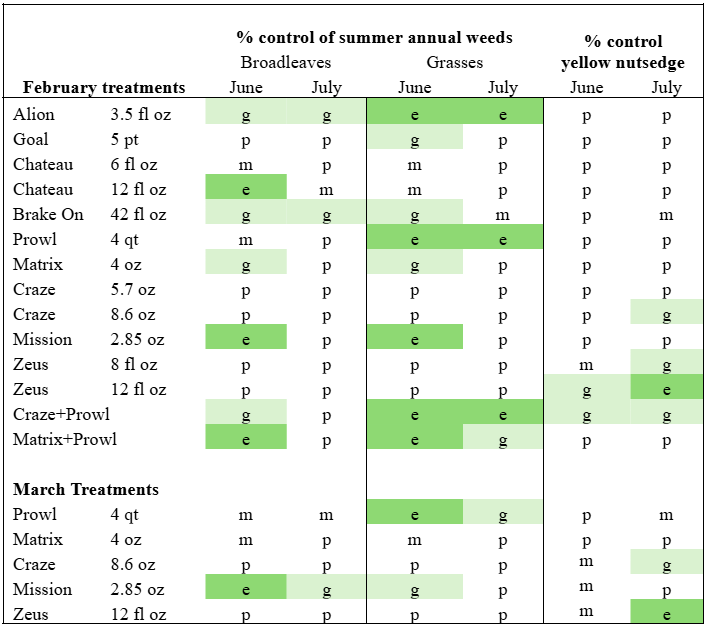
Table 2: The effect of different pre-emergent herbicides on weeds that germinated or sprouted in summer. Summer annual broadleaves included prostrate spurge, knotweed, and pigweed and summer annual grasses were primarily crabgrass and jungle rice.
Leave a Reply