


Sarah Castro, Prune Cultivar Development Manager, Plant Sciences Department, UC Davis & Dr. Ted DeJong, Professor (retired), Plant Sciences Department, UC Davis
The UC Davis Prune breeding program is currently promoting new, promising French-type selections whose harvest window spans 2 weeks before ‘Improved French’ to 2 weeks after ‘Improved French’. These French-types have a variety of harvest dates, bloom dates and all have low dry away ratios that are sure to draw attention from prune growers who are interested in lowering their operational costs. Many of the cultivars have been test-processed and dried using commercial dehydrators in cooperation with interested growers.
The goal of the breeding program is to breed new cultivars that will broaden the bloom and harvest windows and save grower’s operational costs and stabilize prune production in California. This program is directed toward reducing drying costs with lower fruit dry away ratios and lowering production costs by reducing pruning. We recognize the importance of harvest timing with any new cultivars. See Figure 1 below, it depicts a representation of approximate harvest timings for the most promising items. Many varieties in Figure 1 have many years of data, others are still undergoing testing for attributes such as self-compatibility and heat tolerance.
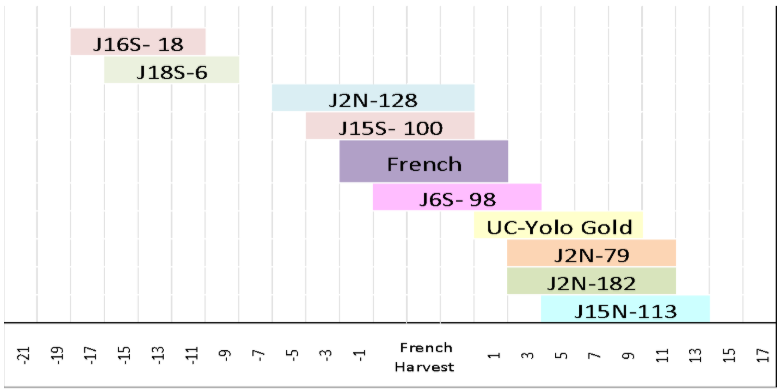
Figure 1. This graphic represents approximate harvest windows in relation to Improved French, based on 2024 & 2025 harvest data. Yearly variations will occur due to location & other environmental factors.
Early Harvesting Items: Items J18S- 6 and J16S-18 have been evaluated in the selection block for two years. There is still more to learn, but the dried fruit quality is excellent. Both items need to be tested for pollen self-compatibility. J16S-18 is especially promising after having a brix of 34 and a dry away ratio of 2.5 in early August.
J2N-128 This prune tree produces purple fruit that harvests with, or just before, ‘Improved French’. The fruit has a fresh to dry weight ratio of 2.2-2.4 with a sweet, satisfying prune flavor. The fruit does not typically get softer than 4 lbs pressure because the fruit will start to dry on the tree rather than softening and falling off. This leafy tree is upright in structure and is more spur bearing than ‘Improved French’. The tree blooms about a week before ‘Improved French’. Thanks to the CA Prune Board’s sponsorship there are about 10 acres of test orchards in the ground for this item. In 2026 we can expect to trial pit it so handlers can decide if it is acceptable for processing. J15S- 100 This item has an expanded planting at our Sierra Gold test block. We will have extra fruit to trial and test in 2026+. We know the pollen is self-compatible and the dried fruit quality is excellent. Harvest timing is something the breeding program is continuing to examine. In 2025 it harvested before ‘Improved French’ on the 19th of August; in 2024, it harvested slightly after ‘Improved French’ on 9/10/24. Regardless, in both years the tree showed great promise with 31 brix in 2024 and 35 brix in 2025 and 2.4 and 2.5 dry away ratios respectively.
J6S- 98 is a promising new prune that has an expanded planting at our Sierra Gold test block. It has great dried fruit quality and an upright and spreading tree structure. The fruit is yellow on the tree, but you would never guess it looking at the dried product. Despite the yellow fruit color, this is still considered a French type fruit. It was harvested too early in 2024 but still had a brix of 26 and dry away of 3.2. In 2025 it was harvested right at ‘Improved French’ timing and had 31 brix and 2.6 dry away. We hope to test pit some in 2026 or 2027 when there is adequate fruit from our block at Sierra Gold.
J2N-79 This prune tree produces dense, purple fruit that harvests around or after ‘Improved French’. The fresh to dry weight ratio ranges from 2.0 to 2.9 depending on how long the fruit hangs on the tree before harvest. The fruit does not soften like ‘Improved French’, sugars increase due to fruit partially drying on the tree and consequently the flesh does not soften. The dried fruit is very dense and tough in its natural condition before pitting, but the processed fruit is very pleasant to eat with soft flesh and texture. The fruit size varies depending on crop load. This tree should not be over-cropped. The flowers typically bloom 6 days before ‘Improved French’, and the pollen is self-compatible. Tree structure is upright with a tendency to be spur-bearing. Thanks to the CA Prune Board’s sponsorship there are about 10 acres of test orchards in the ground for this item. In 2026 we can expect to trial pit it so handlers can decide if it is acceptable for processing.
J2N-182. This item harvests after ‘Improved French’, and blooms 11 days before ‘Improved French’. J2N-182 has excellent eating quality and arguably has the best dried fruit taste of all of our selections. If overcropped, the fruit will be small and the low dry away ratio, compromised, so thinning is important on heavy crop years. This tree produces fruit early in life and will self-pollinate. We have more to learn about this item, but so far it has proved very promising. There are 2 acres of test trees in Winters, CA.
UC-Yolo GoldTM (Patent name “UC G2S-8”)
Pro: Tastes superior
Con: Doesn’t mix with ‘Improved French’.
This newest release from UC Davis is a beautiful yellow fruit that blooms approximately 4 days before ‘Improved French’ and is ready for harvest approximately 10 days after ‘Improved French’. The fresh fruit is oval shaped and maintains its oval shape when dried. Fresh fruit weight is larger than ‘Improved French’ and dried fruit ranges from 9.8 to 11.9 g. Fresh to dry fruit weight ratios range from 2.5-3.1 depending on sugar content and fruit maturity. Fruit sugar contents range from 22 to 27 oBrix and fruit sugar content appears to be more affected by over-cropping than fruit size. The flowers are pollen self-compatible. The tree grows fairly upright and bears primarily on spurs and short shoots. The tree is more precocious than ‘Improved French’, meaning it will produce fruit early in its life. This tree has been selected primarily for its consistent bearing and dried fruit quality and flavor. The patented name is ‘UC G2S-8’ but it is trademarked under the name ‘UC-Yolo GoldTM’.
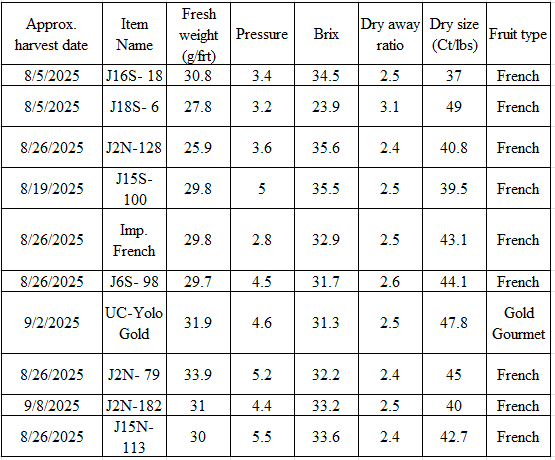
Table 1. Newest promising items available for testing from the UC Davis Prune Breeding program. These cultivar’s approximate harvest dates are imaged above in the harvest timing graphic.
UC Davis Program Information
The prune breeding program is funded by the Prune Board of California. The goal of the breeding program is to breed new cultivars that will broaden the bloom and harvest windows and save growers on operational costs and stabilize prune production in California. The main costs the program tries to reduce are drying costs (via dry away ratio) and pruning costs. The program has many new items every year that are commercially viable candidates for future release. We try hard to test these items as much as possible, but help is needed from the industry to thoroughly evaluate them. For example, rootstock compatibility specifically with Krymsk 86 is still being determined. Extra tests around California help bolster our confidence that these items will reduce grower costs and revitalize the California prune industry. If you are interested in planting some new cultivars, please contact Sarah (scastro@ucdavis.edu). The Prune Board has a subsidy program that helps reduce your financial risk. Another way to learn about this program is to follow it on Instagram @cali.prunebreeder.
Leave a Reply