


Franz Niederholzer, UCCE Farm Advisor, Colusa and Sutter/Yuba Counties
Bad bloom weather – extreme heat, cold, or extended wet weather – can drastically reduce or eliminate commercial prune crops in the Sacramento Valley. Such bloom weather is a major economic stress to growers and costs California packers market share internationally, further impacting prune economics in this state.
What’s being done to overcome this major issue? To date, research into bloom weather related prune crop failure focused on 1) understanding bloom weather conditions impacting fruit set, 2) testing practices or material(s) at bloom to improve crop set under extreme weather, and 3) testing practices which shift bloom timing, potentially avoiding bloom during extreme weather. Here’s what UC researchers and extension advisors have learned so far.
Weather impacts on bloom range from frost to extreme heat.
- Critical bloom temperatures for freeze damage are established (see Table 18.2 in Prune Production Manual, p.201). Buds at certain development stages are damaged following 30 minutes of exposure to certain temperatures. The explanation for crop loss due to heat at bloom is not so simple.
- The greatest risk for crop loss is when bloom is early (before March 15) and extreme weather hits during bloom – high temps above 80oF at or just after full bloom or extended cool, wet weather through bloom.
- Maximum pollen tube growth occurs with temperatures in the mid-70’s, while temperatures under 60oF and over 80oF slow pollen tube growth. Bloom weather supporting the best fruit set conditions is consistent warm days in the mid-70’s from popcorn through petal fall. Extended cool temperatures (under 60oF) or wide swings in daily temperatures (for example, from the low 60’s to over 80-81oF and back into the 60’s) can result in very low fruit set as most conditions the flowers experience are for poor flower activity (measured by pollen tube growth). When heat spikes hit just at or within a day or two after flowers open, fruit set is most heavily impacted.
What can prune growers do to avoid crop failure when the weather forecast is for heat at bloom?
To date, no “rescue sprays” have improved fruit set in field trials.
Cooling the orchard:
Micro-sprinkler irrigation during hot days can reduce orchard temperatures by several degrees (F) and could be the difference between good set or bad, depending on the maximum temperature in the orchard. Irrigation only needs to be run when temperatures are hot (over 75oF). Drip or flood irrigation provides little temperature drop during bloom.
Another option to try to improve the chances of good weather when flowers open is to advance prune bloom with dormant spray, hopefully into cooler weather. This approach isn’t always successful in avoiding bad bloom weather but, going back to 205, delivered good fruit set in at least 50% of cases with extreme bloom heat while untreated trees set very poor crops. Spraying horticultural oil in late December through January advanced full bloom 1-3 days over unsprayed trees in research done in 2008-2010. See the results in Table 1. Results were highly variable within the same year and across years.
A dormant spray of CAN17 fertilizer + non-ionic surfactant (NIS) applied to primarily address nitrogen (N) deficiency and provide N and calcium to buds ahead of bloom is another way to advance prune bloom. Like oil sprays listed above, CAN17+NIS was tested in 2008-2010 in Sutter and Yuba Counties using 25% CAN17+2%NIS in 100 gallons per acre. This combo at a lower rate (12.5%CAN17+0.5%NIS) was reexamined in 2025 in south Butte County using the same spray volume. In 2025, later spray dates were used to retest the benefit of February timings. See the results in Table 2. As with oil sprays, results varied within and across years.
Please note: If the soil and/or trees are dry when spraying, a heavy oil rate (4 gallons of oil/acre) can cause oil burn (phytotoxicity). Spraying high rates of CAN17 on dormant prune trees (January) has not damaged the trees in a total of six years of research, but use of this material for nutrition and bloom advance should be approached very carefully. Consult with an experienced PCA when considering advancing bloom with any spray material.
When spraying in late December or January to advance prune bloom, weather conditions (before, during, and after spraying) influence the bloom effect of the spray. Spraying in early December or in February generally produced less bloom date change than late December through January window.
Research will continue to develop a better understanding of what influences bloom timing and fruit set.
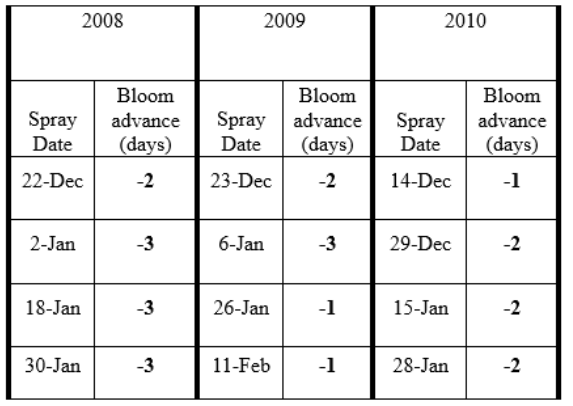
Table 1. Advance in bloom date after spraying horticultural oil (4 gallons per acre of 440 supreme oil) on specific days over unsprayed (no dormant spray) prune trees. 2008-2010. Spray dates varied due to local weather conditions.
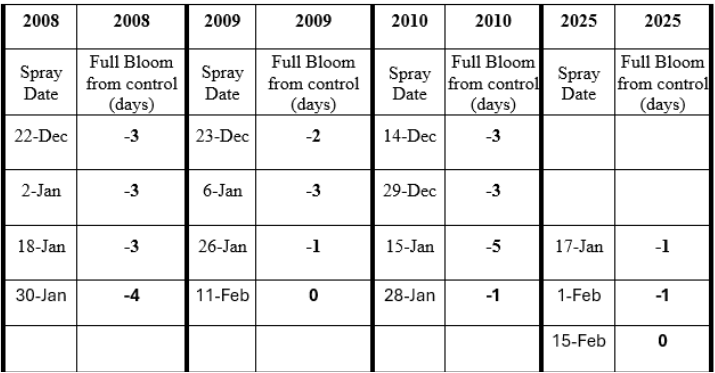
Table 2. Advance in bloom date after spraying CAN17 fertilizer + non-ionic surfactant on specific days over unsprayed (no dormant spray) prune trees. 2008-2010, 2025. Spray dates varied due to local weather conditions. In 2025, 12.5% CAN17+0.5%NIS was used. In all other years, 25% CAN17+2%NIS (v/v) was sprayed.
Leave a Reply