


Jaime Ott, UC Extension Tehama, Shasta, Glenn, and Butte Counties
This work was partially funded by the Stockton East Water District
Crown rot and root rot caused by Phytophthora species are diseases of great concern for almond growers. Many people believe that irrigating with surface water puts your trees at risk of Phytophthora, and that irrigating with groundwater is the best way to prevent these diseases. However, a recent study of Phytophthora in irrigation water and orchard soils tells a different story.
The Bottom Line:
Irrigation management is Phytophthora management. This study showed that Phytophthora is common in orchard soils. Regardless of whether they are irrigated with surface water or groundwater, over 30% of tested orchard soils were positive for Phytophthora. Since water (either standing water or saturated soil) allows Phytophthora to cause disease, good irrigation management is crucial to prevention, no matter what your water source.
- Reduce ponding: irrigation application rate should not exceed soil infiltration rate
- Reduce length of soil saturation: run shorter sets (24 hrs max) more frequently
- Avoid water on the trunk of the tree and avoid soil saturation at the trunk: plant on berms, use stream splitters, choose microsprinkler wetting patterns that avoid the trunk, move drip emitters away from the trunk
Using a resistant rootstock is an excellent tool to help limit Phytophthora disease if you are planting a new orchard (see this chart for rootstock info) or putting in replants. Even with a resistant rootstock, good irrigation management is crucial because no rootstock is immune.
The Details:
Phytophthora is a genus of fungus-like organisms which contains over 200 different species. Many of these species are important pathogens of orchards, causing root rot or crown rot (for example Phytophthora cinnamomi, Phytophthora cactorum, and Phytophthora mediterranea) or pruning wound cankers (mainly Phytophthora syringae). Many previous studies have shown that Phytophthora species are common in surface sources of irrigation water, such as rivers, canals, and sloughs. Phytophthora has not been found in groundwater from wells, unless that well has been contaminated with surface water. From this, people have assumed that irrigating with surface water puts an orchard at risk of Phytophthora root or crown rot, and that irrigating with groundwater is ”safe.” However, biology is rarely that simple: in my experience, orchards irrigated with groundwater can struggle with Phytophthora, and many orchards irrigated with surface water do not show symptoms of Phytophthora disease.
In 2021 and 2022, collaborators and I conducted a study to look at the effects of Phytophthora in irrigation water from a broader perspective. This study took place in the Stockton East Water District (SEWD), a local water agency that manages both groundwater and surface water use by agricultural producers east of Stockton, CA. The study had three objectives:
- Test SEWD surface water for Phytophthora during the irrigation season
- Test for live Phytophthora coming through irrigation emitters
- Test orchard soils for Phytophthora, comparing orchards irrigated with surface water vs groundwater
Objective 1. Test SEWD surface water for Phytophthora during the irrigation season
During the 2021 irrigation season, we sampled water from surface water irrigation sources throughout the SEWD. Some locations (core sites) were sampled monthly from June through October, and some locations (additional sites) were sampled twice during the season, in July and October. Samples were taken back to the lab and tested for Phytophthora using DNA sequencing.
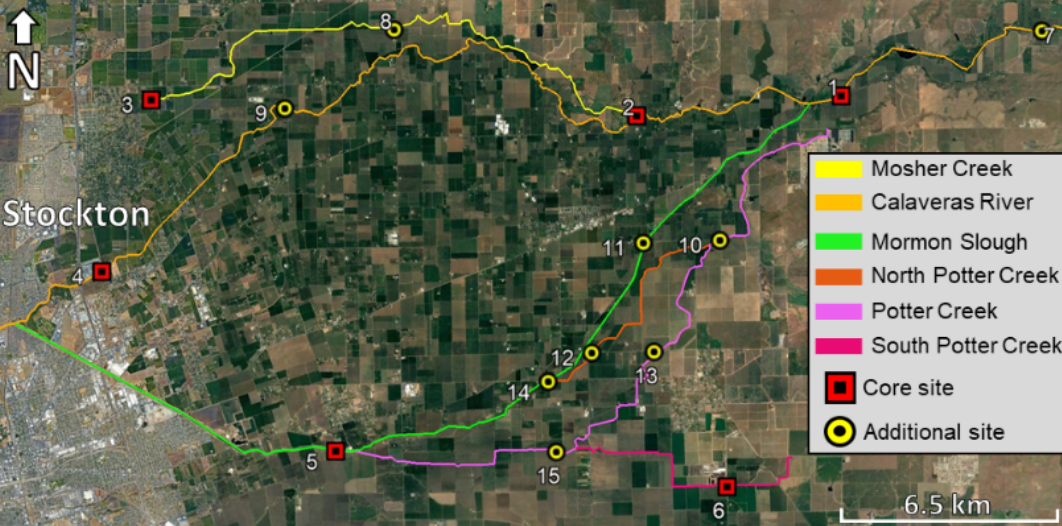
Overview of the Stockton East Water District (SEWD) with water sampling sites marked.
We found that Phytophthora species were common in SEWD waterways. Over the course of sampling, we found 39 Phytophthora species, 10 of which are known pathogens of orchards crops grown in the SEWD. Many of these species were found throughout the irrigation season. We did find that different waterways had different Phytophthora species, and some waterways had more orchard pathogens than others. However, every waterway, and nearly every site, had at least one Phytophthora species of concern to orchards. These results are consistent with many previous studies, which have determined that Phytophthora species are common in surface sources of irrigation water.
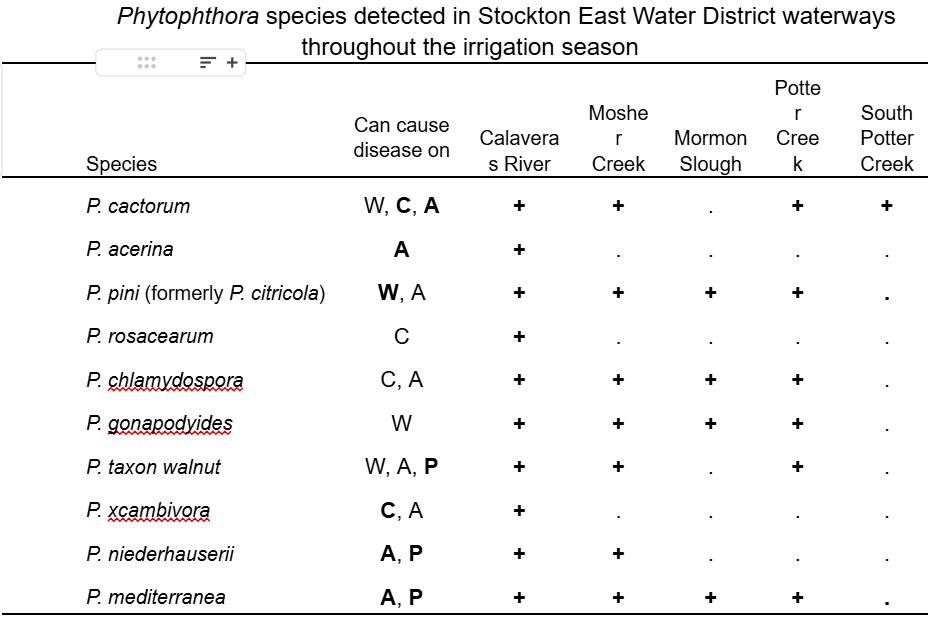
The Phytophthora species listed in this table are reported to cause disease on walnut (W), cherry (C), almond (A), or pistachio (P). If the crop is bold, the Phytophthora species is particularly aggressive on that crop. A plus (+) indicates that the Phytophthora species was detected at least once in that waterway. A period (.) indicates that the species was not detected in that waterway. Nineteen other Phytophthora species (not listed) were detected, but these are not known to cause disease on orchard crops.
Objective 2. Test for live Phytophthora coming through irrigation emitters
In objective 1 we determined that Phytophthora is common in the SEWD waterways. However, very few studies have looked at whether Phytophthora in a waterway can get into an orchard through the irrigation system. This is especially true of drip irrigation systems, which require substantial filtration of surface water to keep emitters from plugging.
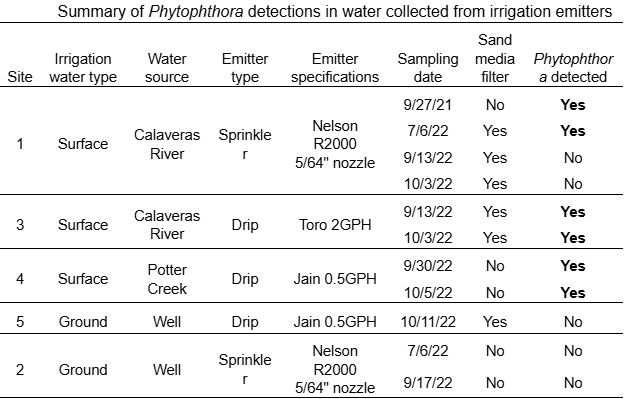
During the 2021 and 2022 irrigation seasons, we collected water directly from irrigation emitters during a normal irrigation and tested this water for the presence of live Phytophthora. This was done in three surface-water-irrigated orchards, two with drip emitters and one with sprinklers, as well as two groundwater-irrigated orchards, one with drip emitters and one with sprinklers.
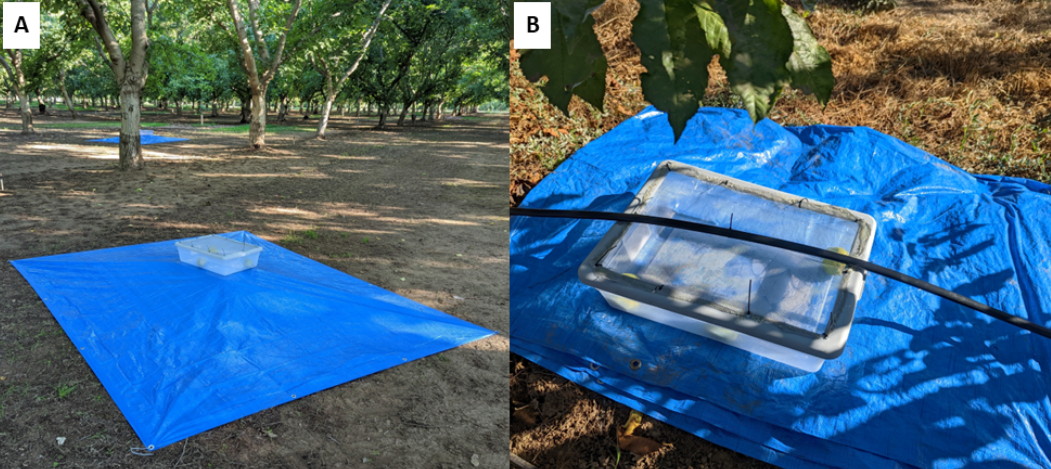
Orchard sampling stations used to detect live Phytophthora in water from A, sprinklers and B, drip emitters.
We found that Phytophthora commonly survives the journey from surface water sources into the orchard, and that the irrigation system type did not seem to matter. Also, the presence of a sand media filter did not seem to affect how regularly we detected live Phytophthora coming through irrigation emitters.
Objective 3. Test orchard soils for Phytophthora, compare orchards irrigated with surface water vs groundwater
In objectives 1 and 2 we determined that Phytophthora is common in SEWD waterways and that it can survive the trip through an irrigation system and into the orchard. However, in most cases Phytophthora must survive in the soil to infect the orchard when conditions are right. Even though we knew that irrigation with surface water is bringing Phytophthora into orchards, we didn’t know if this affects the incidence of Phytophthora in orchard soils.
In 2021, we collected soil from 20 SEWD orchards exclusively irrigated with groundwater for at least 60 years and from 20 SEWD orchards mainly or exclusively irrigated with surface water over the same timeframe. This soil was tested for the presence of Phytophthora species using both the DNA sequencing from objective 1 and the live detection methods from objective 2.
We found that Phytophthora is common in orchard soils, with 32.5% of sampled orchards (13 out of 40) testing positive. We also found that the source of irrigation water did not affect the chances of finding Phytophthora in the soil: groundwater irrigated orchards were as likely to have Phytophthora as orchards irrigated with surface water. This indicates that irrigation with surface water was not the main factor determining whether Phytophthora was present in orchard soils and that irrigation with surface water may not increase risk of Phytophthora disease in orchards.
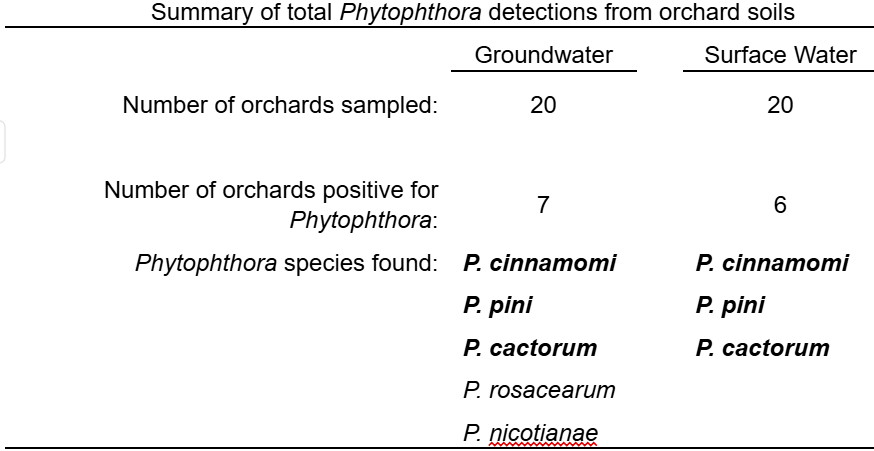
Phytophthora species in bold are particularly aggressive on orchard crops
The results from this study confirm that Phytophthora is common in surface water but show that irrigating with surface water was not the main factor determining whether Phytophthora was present in an orchard. Where is the Phytophthora coming from? It is hard to know, but historical flooding may play a role. We also know that Phytophthora can be moved into an orchard on planting material and in soil on equipment. Where does this leave us in terms of management? This study shows that Phytophthora is very common in orchard soils, regardless of the source of irrigation water. Since over 30% of tested orchards were positive for Phytophthora, it would be prudent to assume you have Phytophthora in your orchard. Saturated soil allows Phytophthora to infect and cause disease, so good irrigation management is crucial to prevention. By “good irrigation management”, I mean that you want to reduce the length of time that orchard soils are fully saturated and avoid having standing water. This can be done by using irrigation emitters with output volumes suited for your soil infiltration rate and by irrigating more frequently for a shorter duration (24 hrs maximum). In addition, you want to apply irrigation water in the root zone but away from the trunk to reduce the opportunity for infection of the trunk or major roots. This can be done using stream splitters with sprinklers to protect the trunk, choosing a microsprinker wetting pattern that avoids the tree trunk, or moving drip emitters away from the trunk of the tree. At planting, consider using a resistant rootstock, and plant on berms. Note that even if you are using a resistant rootstock, good irrigation management is crucial because no rootstock is immune.
I want to leave you with this thought: irrigating well is much more important for preventing Phytophthora than the source of your irrigation water. I have been to many surface-water-irrigated orchards with no symptoms of Phytophthora. Some of the worst orchards I have seen, in terms of Phytophthora disease, were irrigated with groundwater with the driplines right against the trunk on 3rd leaf trees. Irrigation management is Phytophthora management.
Thank you to my collaborators on this project, Greg Browne (USDA-ARS) and Mohamed Nouri (UCCE San Joaquin County). Special thanks to Justin Hopkins with the SEWD for his help planning and executing this project. Thank you also to the SEWD growers who welcomed me into their orchards for sampling. This work was partially funded by the Stockton East Water District.
Leave a Reply