


Jaime Ott, Orchards Advisor, UCCE Tehama, Shasta, Glenn, Butte
Red Leaf Blotch (RLB) is a foliar disease of almonds, first identified in 2024 in the northern San Joaquin Valley. In 2025, it was first detected in the Sacramento Valley, and currently the disease has been reported throughout our region. In other countries where this disease occurs, it is considered the most damaging foliar disease of almonds and is what fungicide spray programs are built around. It is likely that RLB will become a significant disease in California almonds.
Symptoms of RLB (Figure 1) first appear in late April to early May as small, diffuse yellow spots on leaves. These spots expand and turn orange, eventually producing reddish-brown spores. Through June and July, leaves curl, become necrotic, and fall off.
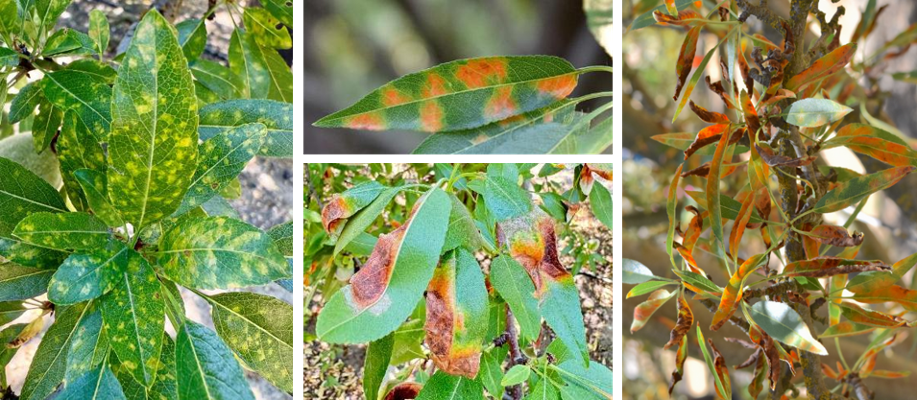
Figure 1. Symptoms of Red Leaf Blotch (RLB). Left: early May, small diffuse yellow spots. Center: mid-June, spots enlarge and turn orange, eventually developing red-brown spores. Right: late July, leaves become necrotic, curl, and fall off (Photo credit Trouillas Lab)
Even though symptoms aren’t visible until May, the infections happen much earlier in the spring. This means that preventative fungicide sprays are the only way to manage this disease, and treatment after symptoms are visible is ineffective. The fungus overwinters on fallen leaves. When it rains in the spring, spores are released which infect newly-emerging almond leaves. These infections can occur during and after rains starting in approximately late February through late April. It is important to note that RLB is not like rust, where spores produced during the season can cause new infections. All the infections for the year are established in the spring.
The most effective products* to control RLB included various mixed fungicides with FRAC groups 3 + 7 (e.g. difenoconazole + pydiflumetofen); 3 + 11 (e.g. difenoconazole + azoxystrobin or tebucnonazole + tryfloxystrobin); 7 + 11 (e.g. fluopyram + trifloxystrobin, fluxapyroxad + pyraclostrobin, or boscalid + pyraclostrobin); 7 + 12 (adepidyn + fludioxonil), and FRAC 3-triazoles (metconazole or flutriafol). Be mindful to follow all label instructions, and to rotate chemistries to prevent resistance development.
Spray timing is crucial for RLB control and is based on leaf emergence and rain. For orchards at risk, the first spray should be at petalfall/first leaf emergence, with a second spray 2-3 weeks later, and, if wet weather continues, a third spray 5-6 weeks after the first. Sprays are most effective if applied right before a rain event.
*any mention of a pesticide product is for illustration only and is not an endorsement or a pesticide recommendation, simply the sharing of research results. Consult your PCA and always read the pesticide label; the label is law.
Leave a Reply