


Curt Pierce, UCCE Water Resources Advisor, Glenn, Tehama, Colusa, and Shasta Counties
Current predictions are for California to experience effects from El Niño conditions that compare with or exceed those of previous El Niño events. Chances that these conditions reach “very strong” or “super” strengths stand at greater than 90% and have only risen with each new forecast. While these effects are expected to be most strongly felt in the southern parts of the state, and along the state’s coastal regions, the Sacramento Valley is still on track to receive above-average rainfall. Additional forecasting for a warmer winter suggests much of this precipitation may fall as mountain rain instead of the mountain snow we rely on to build bankable snowpack to feed next year’s irrigation season.
Put simply, if the current forecasts hold, we could be looking at several months of above-average precipitation, falling primarily as rain, coming off the mountain slopes and into our waterways. With much of the surrounding mountain areas still recovering from recent fires, these flows could be significant. In fact, a state of emergency has already been declared by the governor to allow local authorities to begin planning for the possible effects of the expected winter weather.
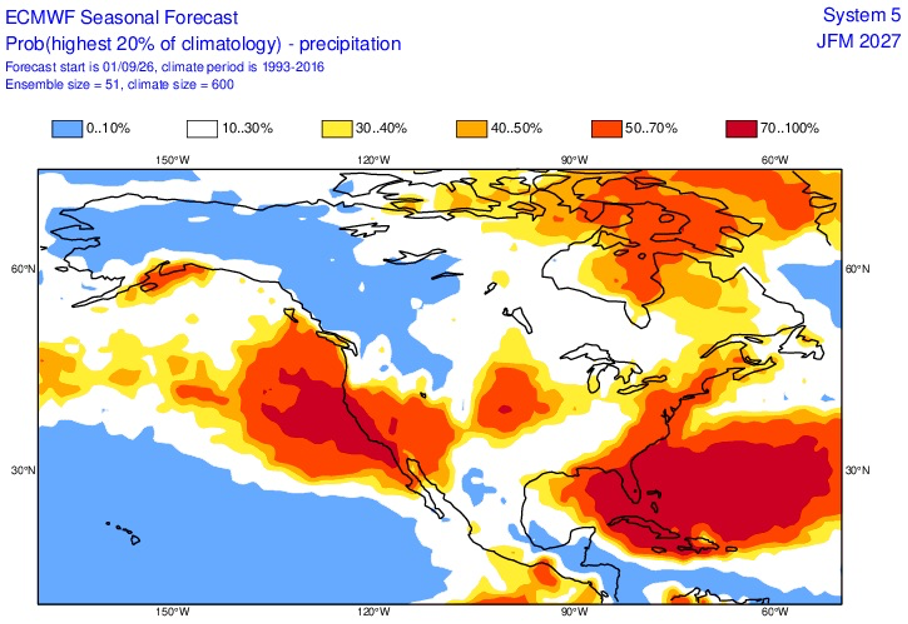
Source: European Centre for Medium-Range Weather Forecasts (https://charts.ecmwf.int/products/seasonal_system5_standard_rain)
Of course, we need the rain. As of now, much of the NSV is deemed “abnormally dry”. Our ability to capitalize on the coming supply of water depends on many of the factors mentioned above: mountain temperatures, rate of rainfall (precipitation intensity), soil conditions on the ground (ability to hold water), and our ability to capture and store the stormflows. Indeed, with warm mountain temperatures, saturated soils below fire-reduced vegetation areas, and the expected high-intensity precipitation events, storage quickly becomes the dominant factor.
So, what can we do? As of mid-September, both Shasta and Oroville reservoirs stand at roughly half capacity, typical for both at this time of year. We can expect those to reach their flood-control ceilings earlier this season than in years past if current predictions hold, meaning that water will need to be released by both reservoirs for them to accommodate for the expected flows later in the season. Several water districts have plans in place with the state to divert some of the water into recharge basins and other areas deemed suitable for recharge activity. It is important to know that current rules require permitting for the diversion of any stormflows, and several districts have completed applications for those permits. While most districts with permits already have identified projects to divert water to, others may be looking for cooperators able to take excess flows they have preliminary permits for should those flows come as expected. If you are interested in what plans your district has in place for stormflow diversion and capture, you are encouraged to reach out to them or attend their next meetings where these plans are being developed and discussed.
Individually, consider establishing or maintaining vegetation to encourage infiltration in orchard alleys. Cover crops and native vegetation have different pros and cons but both help keep soil surfaces permeable. Plant as soon as possible after harvest for best establishment rates. Consider surface grading to provide clear paths for stormflows to exit an orchard. Use berms to slow and divert runoff away from trees and into areas it can get into the soil. In sodium-affected or crusting soils, gypsum can be applied to improve infiltration. Dry ripping can be done on compacted soils, but only when the impacted soils are still dry ahead of seasonal rains. Lastly, organic material such as mulch, hulls and shells, etc. applied to orchard floors can reduce surface crusting and improve infiltration.
Many of these strategies have potential trade-offs such as reduced frost protection, increased pest and disease pressures, etc. so approach each carefully and contact your local UCCE farm advisor if you have questions.
SOURCES:
Forecasts for a record-breaking El Niño for California (https://www.cpc.ncep.noaa.gov/products/analysis_monitoring/enso_advisory/ensodisc.shtml)
Current drought conditions for the North Sacramento Valley (https://www.drought.gov/states/california)
Current reservoir conditions for the North Sacramento Valley (https://cdec.water.ca.gov/resapp/RescondMain)
Sac Valley Orchards website for additional guidance and resources (sacvalleyorchards.com)
Leave a Reply