


Luke Milliron, UCCE Orchards Advisor, Butte, Glenn, and Tehama Counties
Curt Pierce, UCCE Irrigation and Water Resources Advisor, Glenn, Tehama, Colusa, and Shasta Counties
Franz Niederholzer, UCCE Farm Advisor; Colusa and Sutter/Yuba Counties
Summary: For the best returns and orchard health, ease up on irrigation before harvest, then resume full irrigation after harvest and continue until leaf drop. The pressure chamber is the best tool to manage irrigation for optimal tree and fruit results.
What’s going on with the tree? Irrigation decisions leading up to and following prune harvest not only impact this year but also affect future harvests and orchard health. To manage irrigation effectively, we must first recognize what is happening with the tree and fruit as the season progresses. Shoot growth has been declining since early June, fresh fruit size increases slow by the end of July, while fruit dry weight continues to increase until the fruit reaches physiological maturity (4 lbs. pressure). Floral and vegetative bud development for next year’s crop is also taking place, beginning in early summer and ending in late September on this season’s growth (see Figure 1). Prune exhibits varying susceptibility to water stress during these different crop development stages. In part because we are optimizing for dried fruit size and not fresh fruit size, more water is not always the solution in prune production. Deficit irrigation, or supplying the trees with less than full ET (Figure 1), can provide key benefits beyond water savings and reduced pumping costs.
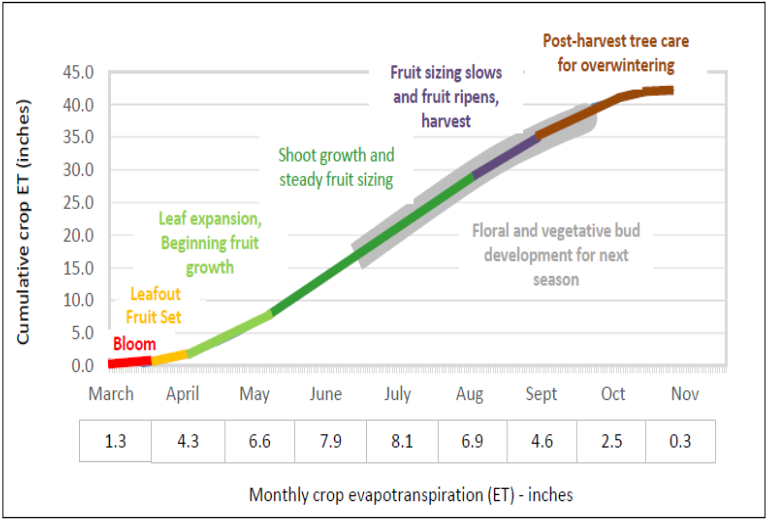
Figure 1. Graphic timeline of prune tree and crop development phases and associated average monthly and cumulative crop evapotranspiration (ET; figure by Allan Fulton, UCCE Tehama Emeritus).
How do you determine tree water status for optimal performance? Although ET calculations and soil moisture monitoring can be used to manage irrigation around harvest time, they do not directly measure the water status of the tree. In contrast, pressure chamber stem water potential (SWP) readings provide direct measurements of tree water status and can help deliver beneficial stress timings while avoiding unwanted severe stress. As you will see below, SWP is also the method we have the most information on for prune production, with Prune Board-funded research producing nuanced recommendations for both pre- and post-harvest irrigation management. ET, soil moisture, and SWP each provide different insights into the puzzle: how much to water, where your water is, and when to water, respectively. The expert irrigator integrates all three approaches.
Matching pressure chamber SWP readings to growth stage for optimal orchard performance: Maintaining minimal to mild water stress with SWP readings between -8 and -12 bars from April to mid-June promotes rapid shoot growth and fruit sizing (Table 1). May and June are also the most critical months for end-cracking, which occurs when irrigating very dry orchards, so shorter, rather than less frequent irrigations, are recommended. For the summer months, SWP readings of -12 to -16 bars from late June up to the preharvest irrigation cut-off can help reduce pruning and pumping costs while not impacting production. Cut off irrigation once fruits have reached physiological maturity (4 lbs. fruit pressure), in the week or two before harvest to achieve -16 to -20 bars SWP. This brief period of moderate to high stress can enhance dry-away ratios and minimize shaker bark injury at harvest. This irrigation cut off may also lead to less early fruit drop if the weather cools or there is a pest outbreak. Growers using Krymsk-86-rooted trees should take special care to ensure the trees are sufficiently dried down before shaking to avoid bark damage.
Once the crop is out of the field, follow through with careful irrigation management until the trees have lost their leaves or there is regular autumn rain. Prompt post-harvest irrigation should recover the trees to mild-to-moderate stress (-12 to -16 bars). Sustained high to severe water stress (-20 bars and lower) during the pre- and post-harvest period can reduce potassium uptake, encourage sunburn and growth of Cytospora cankers (Figure 2), and result in smaller fruit buds the following year.
The Sacramento Valley Orchards website has detailed guides on adopting the pressure chamber and interpreting SWP readings.
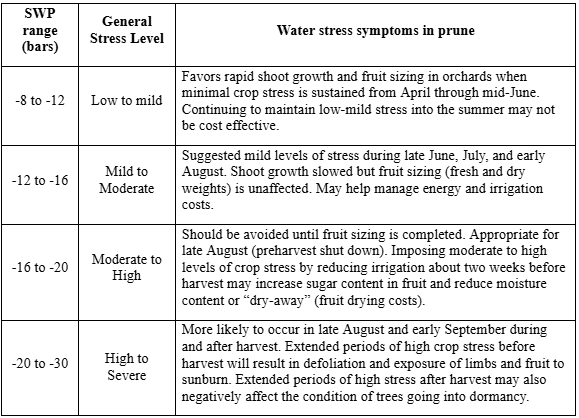
Table 1. SWP levels in prune, consideration of how SWP might compare to baseline values under various weather conditions, and the corresponding water stress symptoms to expect.
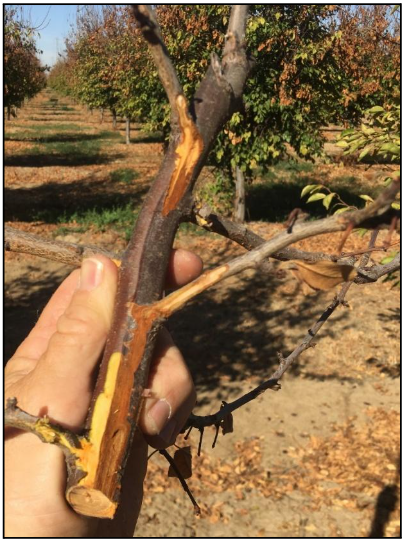
Figure 2. Cytospora canker infections spread most rapidly in severely water stressed (sustained lower than -20 bars SWP) orchards. High to severe water stress is more likely to occur in late August and early September during and after harvest. Photo by Franz Niederholzer.
Leave a Reply