


Clarissa Reyes, Orchards Advisor, Sutter-Yuba, Butte and Placer Counties
While it’s too early to predict how severe weather or pest flights might impact walnut harvest, we do know some basic walnut physiology that can inform our ability to adapt depending on what nature throws our way.
Typically, walnut kernels reach maturity and have the highest market quality 3-4 weeks before they can be harvested, but hulls are not loose enough at that time in the Sacramento Valley. So, while we wait for hulls to loosen from the shell and split, kernel quality may decrease on the tree due to heat, mold, and insect damage.
The point at which walnut kernels are mature, lightest in color, and of highest value is reached when packing tissue between kernel halves has just turned brown, commonly referred to as “packing tissue brown” or PTB. Climate greatly influences this – there is less time between PTB and the time when hulls have separated from the shell in cooler, coastal areas than there is in the hotter and drier valley regions.
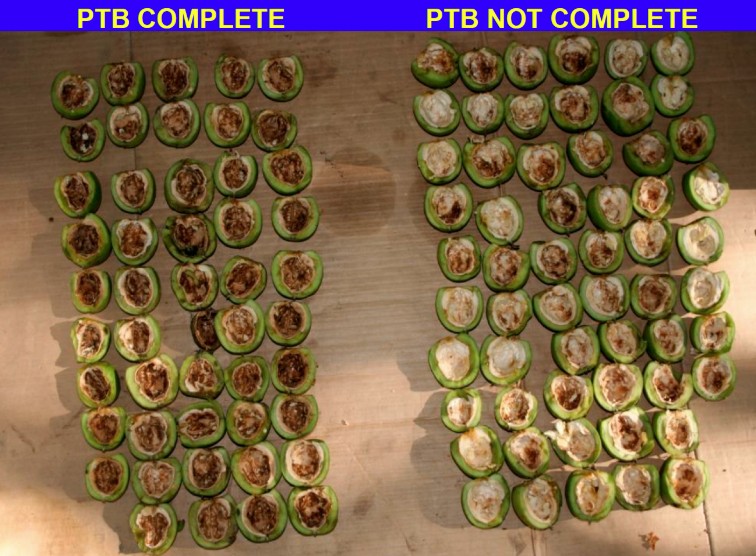
Examples of mature nuts at packing tissue brown (PTB), left, and immature nuts, right. Photo: Bob Beede.
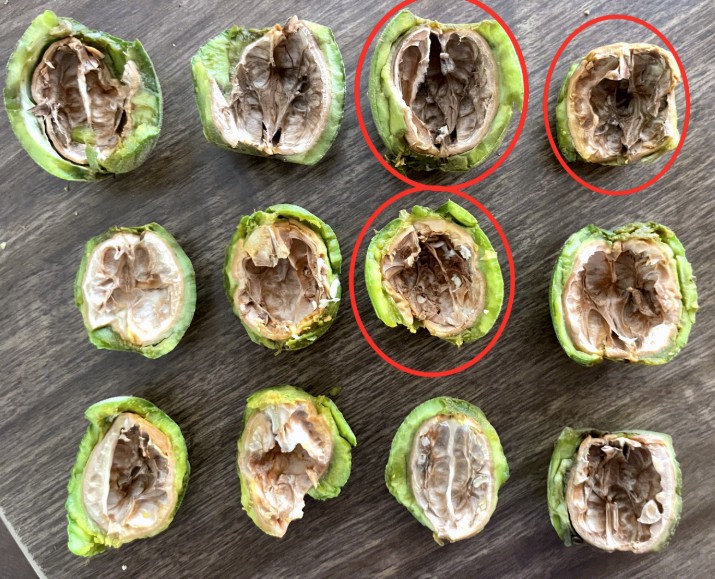
Examples of mature nuts at packing tissue brown (PTB), circled, and immature nuts. Photo: Clarissa Reyes.
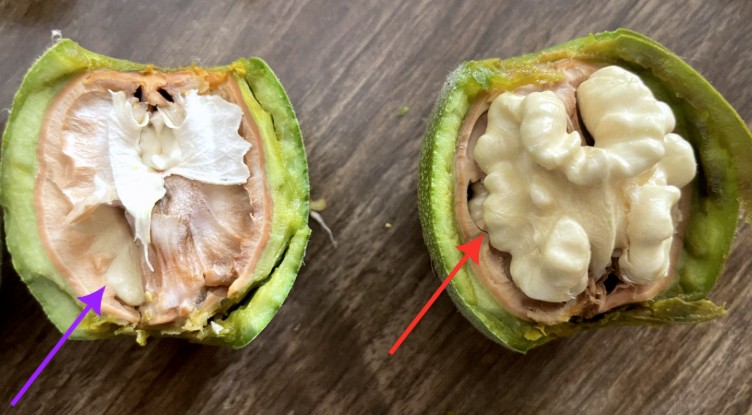
Purple arrow indicating where kernel still attached to packing tissue on immature nut, left; red arrow indicating the kernel detached from the packing tissue close to maturity, right. Photo: Clarissa Reyes
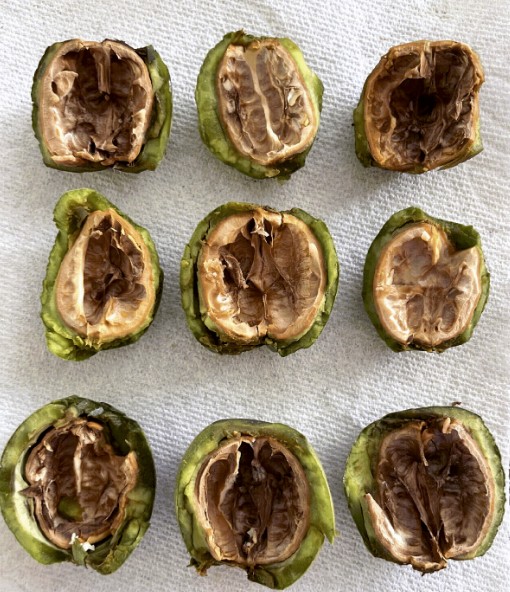
More examples of packing tissue brown. Photo: Clarissa Reyes
Ethephon is a compound that accelerates separation of the walnut hull from the shell. This enables harvest at an earlier time after PTB, when the kernels are at highest quality.
It can be useful to use ethephon 1. To move harvest closer to PTB to preserve kernel quality, or 2. Facilitate a one-shake harvest, which can help with harvest cost efficiency. Both objectives might be worth considering if you have a lot of acreage that will harvest around the same time, because strategic applications among some select blocks can ensure harvest timing will be staggered and that equipment and dryer space will be available at optimal timing.
If your goal is to advance harvest, either to preserve kernel quality or spread out the harvesting of different blocks of the same variety, apply ethephon when 100% of nuts reach PTB. This will move harvest up by 7-10 days, then a second shake should occur approximately two weeks later.
In this case, PTB is accurately assessed by crossing diagonally across an orchard, and collecting 100 nuts, and splitting them in half. This should begin at least two weeks before PTB is expected. Mature nuts will have oak-colored brown tissue throughout the hull. Treatment should not occur until 100% of collected nuts are at PTB.
If your goal is to remove the most nuts in a single shake to save the cost of sending the harvest crew through the block a second time, apply ethephon about 10 days before normal harvest. Even applying ethephon as early as five to seven days after PTB will improve percent nut removal and the chances of having to only harvest once, avoiding an uneconomical second shake. Although a complete harvest (meaning 100 percent in one shake) may not be feasible, a far greater first harvest, and in some cases a near complete harvest, is possible earlier than normal with the use of ethephon.
Ethephon can be a helpful tool to manage harvest timing, but its use comes with some caveats.
- – Research on ethephon application was conducted in the 1970s on Ashley, Chico, Franquette, Hartley, Manchetti, and Payne and in the 1990s on Serr. We do not have replicated research on Chandler or Howard, or newer varieties such as Solano, Durham, or Wolfskill.* Anecdotally, growers report that Tulare produces the most ethylene and nuts fall off the tree shortly after treatment. Howard is responsive to ethephon in Northern California, resulting in increased quality and value. Several growers report success using ethephon on some of their Chandler blocks to stagger harvest.
* What ethephon rates do you use on which walnut varieties to manage your harvests? I appreciate your response to this anonymous survey to inform design of a future ethephon experiment this fall in Howard and Chandler and newer varieties such as Solano and Wolfskill. –Clarissa
- – Ethephon is labeled for use between 300-900 ppm (3-5 pints/acre). Care must be taken with concentration because some varieties are more susceptible to leaf drop than others, which will affect photosynthetic recovery after harvest, and potentially affect subsequent tree growth and nut production the following year.
- – Ethephon is most effective when applied between 60-90°F and with higher humidity conditions. If the weather is predicted to be rainy, hot, or windy, ethephon efficacy is decreased.
- – Ethephon is slow to translocate so complete nut coverage is necessary to achieve the full effect of the application.
- – Growers who do not have their own harvest equipment or who, for some other reason, cannot harvest the crop promptly should not use this material. Once ethephon is applied, harvest must start as soon as feasible to avoid loss in kernel quality.
- – Ethephon should not be used in stressed orchards because this may lead to defoliation. This can complicate harvest due to excessive leaf debris, and again, potentially impact trees the following year.
Some other notes on quality:
Regardless of ethephon use, nut quality is greatly impacted by temperature.
Once the connection between nut and tree is broken and the transpiration stream ceases, the temperature of sun exposed walnut kernels increases rapidly, while sun-exposed nuts on the tree remain cooler. Nuts on the ground exposed to sun will lose quality and value when air temperatures reach approximately 90°F. Placing nuts in the shade minimizes color change. If air temperatures exceed 100°F, even nuts in shade will experience excessive heat that can result in rapid darkening of kernel color. Nuts that are harvested with hulls will reach excessive temperatures faster than those without hulls.
Leave a Reply