


Curt Pierce, UCCE Irrigation and Water Resources Advisor, Glenn, Tehama, Colusa, and Shasta Counties
Deciding when to start irrigating your prune orchard can be difficult. The weather starts to get warm, the soil surface looks dry, and we want to make sure our trees have the best start to the season that we can give them. However, starting irrigations too soon in the season can cause a host of problems in prune orchards that are not always easily attributed to the practice. Saturated soils can promote the growth of pathogens such as Phytophthora, which can cause significant tree damage. Under cooler conditions, high soil water content can lead to elevated bicarbonate levels, reducing iron (Fe) availability and potentially causing Fe deficiency symptoms (Figure 1).
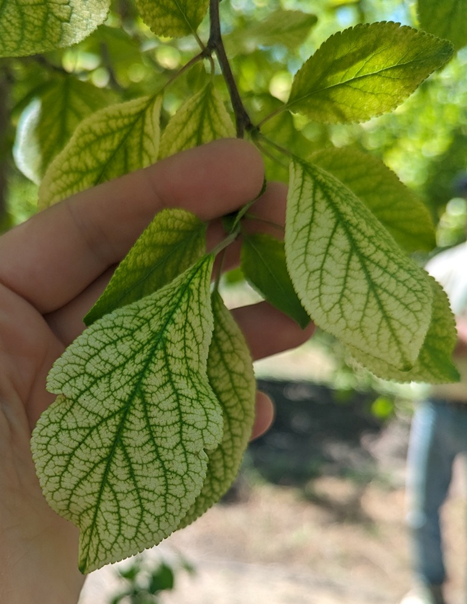
Figure 1. Interveinal chlorosis, a symptom of iron deficiency on prune leaves. These symptoms are often caused by prolonged saturated and cold soils. Photo: Jaime Ott
Perhaps most importantly, starting orchard irrigations too early in the spring can reduce oxygen levels in your soil at the worst possible time: when the trees undergo the most significant flush of new root growth in the year. These new roots that grow and develop throughout the spring months are best suited for nutrient and water uptake. As they develop and age throughout the summer, they provide the expanded root structure from which the next flush of new root growth will stem. While temporarily saturated soils are not likely to kill trees, they can suppress new root growth. (See article in this newsletter on early season fruit growth).
Younger roots need sufficient oxygen to grow and develop, and are especially susceptible to the anoxic conditions of saturated soils. They will be the first roots to die back, depriving a tree critical water uptake capacity, which it will need later in the season when evapotranspiration (ET) rates are at their highest and water supplies are most constrained.
So, what are some good approaches to determine when to start irrigating?
Soil Moisture
Estimating your soil moisture is the most basic method. Using a shovel or auger, you can sample soil from the root zone and get a “feel” for the approximate soil moisture content. Whether using the “feel method” or soil moisture probes installed in your orchard, pay closest attention to areas that are most representative of your orchard as a whole. Probes installed next to orchard edges often under-report soil moisture compared to those inside the orchard due to soil compaction, higher temperatures, and reduced irrigation coverage. Consider data from such probes with those caveats in mind, and prioritize data from representative locations within the orchard.
Monitor the soil moisture within the effective root zone of your trees, down to approximately 3’ from the surface. Many companies supplying soil probes will calibrate them to give direct guidance on when to irrigate, while others may report volumetric water content (VWC) values. Both are typically delivered via a phone or computer application. If using VWC, aim to start irrigations when values are around 25-35% in most soils. Monitoring soil moisture is especially helpful in verifying the effects of previous irrigations and avoiding over-irrigation and soil saturation.
Evapotranspiration (ET)
Crop water use, or ET replacement, is a preferred strategy. A Weekly ET Report is distributed by our offices or can be accessed online. When using an ET replacement method for irrigation, the goal is to match the applied water to the weekly projected ET (factoring in any precipitation and system inefficiencies) and deliver at a rate that doesn’t overwhelm the soil’s water-holding capacity.
To use the Weekly ET Report, you need to know your system’s application rate. This information can be found in your original design documents, from a Mobile Irrigation Lab report (see resources in the bullets of this newsletter), or by sampling a few emitters to calculate an average and then multiplying that by the number of emitters per acre. Calculators to help convert from GPM to acre-inches, the unit used in the ET Report, are available at sacvalleyorchards.com/et-reports, along with video tutorials and other ET-related resources.
Tree Water Status / Stem Water Potential (SWP)
While directly measuring tree water status is the most reliable method for determining when to irrigate during the growing season, it is no longer recommended for scheduling the earliest season sets. Contrary to findings in walnuts, recent work in almonds suggests that timing initial irrigations to when stem water potential (SWP) reaches a bar or two below baseline values may negatively affect production factors. Though more research is needed on prunes, their closeness to almonds, relative to walnuts, warrants caution when using SWP or tree water status to schedule season-starting irrigations in prunes.
Leave a Reply