


Dr. Rich Rosecrance and Karla Caldera, Department of Plant Science, California State University, Chico
Potassium (K) plays a major role in prune production—fruit size, sugars, and dry-away. Many growers use foliar potassium to supplement soil programs, but results can be inconsistent. Recent field trials using rubidium (Rb) as a tracer help explain why. The results show that timing and crop load largely determine whether foliar K actually makes it into the fruit.
Start with the basics: Soil potassium still matters most
All soil-applied potassium sources tested (coarse SOP, fine SOP, and KTS) performed similarly (Figure 1).
- Leaf K stayed in the adequate range
- No differences in fruit size
- KTS applied later ran slightly lower, but still within K sufficiency range
Takeaway: Keep soil potassium as the foundation of your program. Choose products based on price and application fit, not expected performance differences.
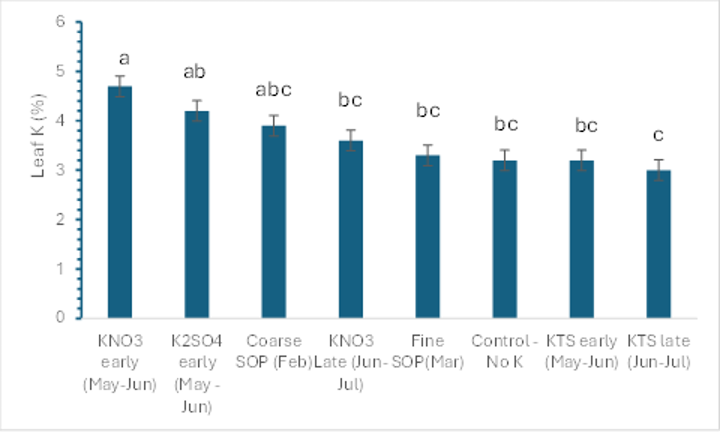
Figure 1. Percent leaf potassium in July in prune trees treated with seven different treatments of soil-applied potassium, as well as an untreated control.
Foliar Potassium: Timing Matters
Foliar K moved out of the leaf within about 3–5 weeks after application (Figure 2).
- – May–June: good movement into fruit
- – July and later: much more K stayed in the leaves
Early in the season, the tree is moving nutrients efficiently to fruit. Later in the season, that movement slows and foliar K is far less likely to reach the crop.
Takeaway: If you’re going to spray foliar K, do it early (May–early June).
Crop Load: The Driving Force
Crop load had the biggest impact on whether foliar K reached the fruit (Table 1).
Table 1. How crop load affects where foliar potassium ends up:
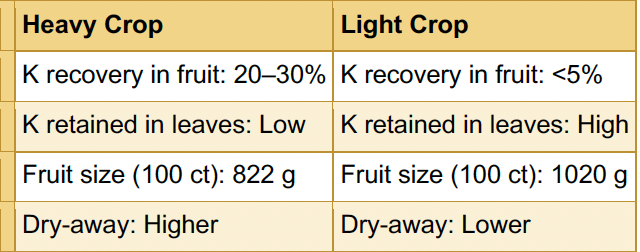
In heavy crop years, fruit act like a strong sink, pulling potassium out of the leaves and into the fruit. In light crop years, that demand isn’t there, so most of the foliar K stays in the leaves or is stored in branches.
Takeaway: Foliar potassium is a high-return input in heavy crop years, but a low-return input in light crop years.
Foliar Fertilizer Source: Efficiency vs Cost
Potassium nitrate (KNO₃) moved more potassium into fruit than potassium sulfate (K₂SO₄). Sulfate sources were about 65–70% as effective. At current prices, KNO₃ is only about 4% more expensive per ton. So you’re paying slightly more for a material that delivers quite a bit more K to the fruit.
Whether that pencils out depends on the crop:
- – Heavy crop: Higher efficiency likely pays
- – Light crop: Most of that extra K doesn’t reach the fruit
In light crop years, much of the foliar K (and associated N) remains in the tree. That material is not lost; it can be stored in wood and roots and used later, but it doesn’t help this year’s crop.
Takeaway: Foliar KNO₃ applications can be worth it in heavy crop years and early applications. In lighter crop years, a lower-cost material (K₂SO₄) may make more sense. Foliar K in light-crop years may act more as a reserve-building input than a fruit-sizing tool.
Practical Recommendations
- – Keep a solid soil potassium program
- – Use foliar K as a supplement, not a replacement
- – Spray early (May–early June)
- – Focus on heavily cropped blocks
- – Consider KNO₃ when crop demand is high
- – Avoid relying on late-season foliar sprays to improve fruit size or dry-away
Leave a Reply