


Franz Niederholzer, UCCE Advisor, Colusa and Sutter/Yuba Counties
Bloom is the most important time of year for adequate boron (B) and zinc (Zn) levels in almonds. Zinc is essential to many processes such as cell division, protein synthesis, and auxin synthesis in growing points (flowers and shoots), and bloom is the time of the most growing points in a tree. Boron is essential for cell wall synthesis and division. Boron fertilization has improved fruit or nut set compared to deficient plants in research in many tree crops, but only if applied in time to get B into buds at bloom. Both Zn and B can be absorbed into leaves and translocated within almond trees.
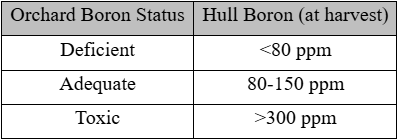
Check leaf symptoms, summer leaf analysis, or harvest hull analysis results to see if Zn and/or B fertilization is needed. Zinc deficiency produces “little leaf” symptoms with trees showing summer leaf levels of 15 ppm Zn or less considered deficient. Trees with hull B levels below 80 ppm B at harvest are deficient, but almond yield may benefit from B application if hull levels are below 150 ppm B. Do not fertilize with B if hull levels are 300 ppm B or greater, as excessive B is toxic to plants.
A fall spray is a cost-effective way to get Zn or B into buds for the following year’s bloom. The return on investment for a fall B spray can be significant. Yield increases of 200-400 kernel pounds per acre have been measured from a foliar application the previous fall at Nickels Soil Lab of 0.6 lbs. of actual B (the equivalent of 3 lbs. Solubor®/acre applied in 400 gallons/acre). A fall Zn spray should increase leaf Zn the following year and eliminate Zn deficiency symptoms while reducing the risk of phytotoxicity compared to spraying between petal fall and harvest. The following are tips that may help maximize the benefit from a fall Zn and/or B spray.
- Materials: Zinc sulfate is a good, cost-effective source of zinc in postharvest applications. Other sources work but are more expensive. Most B sources (polyborate, boric acid, etc.), if a similar rate of actual B is applied, are effective foliar fertilizers. See the tank mixing section below regarding different B fertilizers and zinc.
- Zn Rates: A moderate rate of Zn, for example, 5 lb. zinc sulfate (ZnSO4)/acre, applied in October, is as effective as higher rates applied in November when natural leaf drop begins. The 5 lb. ZnSO4/acre rate in October will not remove leaves, allowing for continued carbohydrate production and storage for use next growing season. To get defoliation in addition to fertilization, use higher rates – for example, 20 lbs ZnSO4/acre – once natural leaf drop has begun. In my experience, defoliation with zinc fertilizer sprays requires moisture in the orchard – either from rain or irrigation.
- B Rates: Generally, 1-2 lbs Solubor®/acre in 100 gallons per acre is recommended as a fall spray. Excess B can be toxic. Consult an experienced PCA/CCA when selecting a B rate. If the canopy is healthy and green, B sprays should be absorbed into November, even when tank mixed with a high rate of ZnSO4. Note: Almonds export 0.2-0.3 lb. B in a 1000 lb. per acre kernel yield crop (in kernels, shell and hulls), so a good almond crop will remove the equivalent of 2 lbs. Solubor®/acre from the orchard and hull B levels next harvest shouldn’t change as a result of a B spray this fall.
- Tank mixing: To reduce application costs, Zn and B can be tank mixed. When using polyborate B fertilizer (Solubor®, Borosol®, etc.) certain steps should be taken. Acidify the spray solution to pH 5 before adding zinc using an organic acid-based material (for example, Mixwell™ or Tri-Fol®) and not a phosphate buffer (will precipitate with zinc). Then add B. If the solution pH climbs above 5, a light brown haze (precipitation) forms in the tank and lower boron levels in the flowers the following spring can result. Add more acid to eliminate the haze. If a boric acid product is used, acidification is not needed.
- Soil applied B and/or Zn: Postharvest soil applied B will not increase flower B levels the next spring, but it should increase hull B by next harvest. Adequate B at bloom is the goal, but both a fall foliar spray and spring-summer soil application(s) may be required if the orchard is deficient. If an orchard is B deficient (<80 ppm hull B) an in-season soil application of 2-4 lbs actual B (10-20 lb Solubor) per acre is recommended. Multiple applications instead of a single large dose should deliver best results.
- Canopy Health: Boron is readily absorbed by leaves, not wood, so foliar application in an orchard with extensive postharvest defoliation is not recommended. A pink bud B spray maybe be a better B fertilizer delivery option.
- Aerial application: University of California research has not tested aerial B applications in almond. If considering aerial applications, the safe recommendation is to keep spray tank B concentrations similar those in ground rigs – 0.4 B/100 gallons = 2 lbs Solubor/100 gallons. Higher concentrations risk reducing yield, so proceed with caution.
**************************************************************************
Zinc is deficient < 15 ppm in July leaf sample. If there is an in-season zinc spray it could result in falsely high zinc levels, even if samples are washed.
Nutrients can damage trees if effective and safe rates, materials, and/or application practices are not used. None of the information above constitutes a fertilizer recommendation, merely the sharing of educational resources. Consult with your Certified Crop Advisor (CCA) in developing your fertilizer plan.
Leave a Reply