


Jaime Ott, UCCE Tehama, Shasta Glenn, Butte Counties
Given the early bloom and leaf-out of our walnuts this year, spring rain will put us at risk of blight. At the time of writing, we are already past catkin expansion and into leafout in the orchards I monitor. This would be a year to have started your blight spray at prayer stage (when female flowers emerge), and to spray based on the weather.
- With little or no rain predicted during early bloom, start spraying at prayer stage (when female flowers emerge). This is the single most effective spray timing for blight control.
- Ensure you are getting good coverage—blight materials are preventative and can only protect what they cover.
- Use tank mixes and rotate materials between each spray.
Walnut blight, caused by the bacterial pathogen Xanthomonas arboricola pv. juglandis (Xaj), is a major disease affecting walnuts in our region. Xaj infects young tissues (leaves, catkins, female flowers) as they emerge in the spring and is favored by rainy weather. In years like 2026, with our strangely dry spring weather, most growers will be able to hold off on their first blight spray until the female flowers emerge, which coincides with prayer stage for the leaves. After that, spraying can be done based on the weather, or every 7-10 days if we go through a rainy period during the remainder of bloom and leafout.
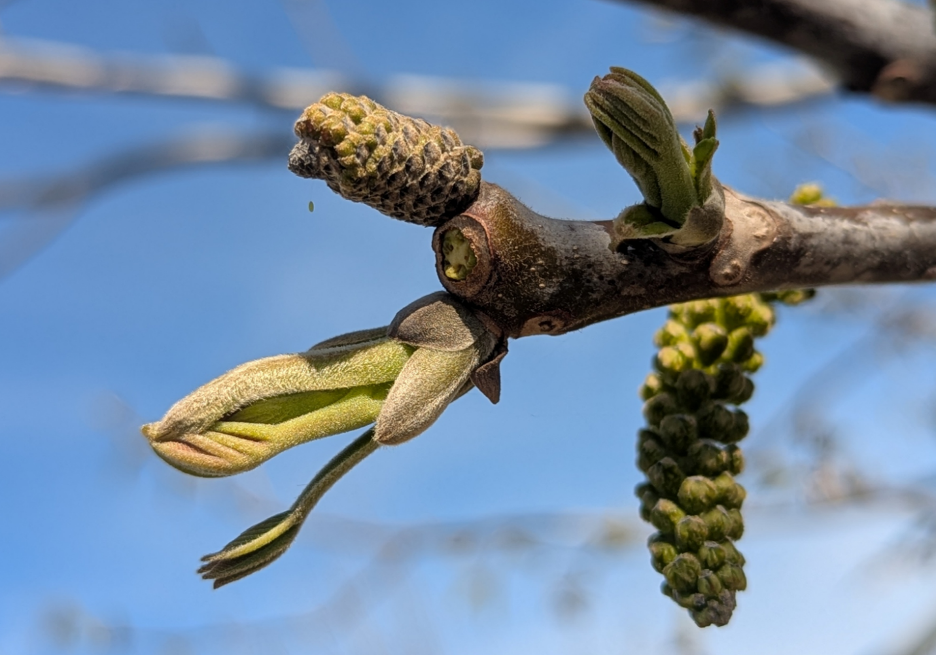
When the weather is dry at the beginning of bloom and leaf-out, many growers can wait to begin blight spraying until the leaves reach prayer stage (pictured).
The materials we use to control blight are all preventative and require excellent coverage to work—if tissue is not covered, it is not protected. Generally, failures in blight management can be traced to one or more of the following mistakes: wrong timing (first spray too late), poor coverage (every-other row application, poor coverage at the bottom from aerial sprays or at the top from ground sprays), and wrong material (using a single material instead of tank mixing, using less than the labeled rate, using a weak material in an orchard with high blight pressure). UC researcher Dr. Jim Adaskaveg recommends always using a tank mix, and rotating mixes with every spray. This will provide you with the best blight control and help prevent resistance developing in Xaj. Note that copper resistance is already common in Xaj throughout the state, but tank mixing copper with mancozeb or kasugamycin can overcome that resistance*. See the UCIPM Fungicide and Bactericide Efficacy Table for more information.
For more information on walnut blight, see these article at SacValleyOrchards.com:
Walnut Blight Management, posted 2025
Walnut Blight Management, posted 2020
*any mention of a pesticide product is for illustration only and is not an endorsement or a pesticide recommendation, simply the sharing of research results. Consult your PCA and always read the pesticide label; the label is law.
Leave a Reply