


Elizabeth Fichtner, UCCE Farm Advisor, Tulare County
Carlos Crisosto, CE Specialist, Postharvest Physiology
Bruce Lampinen, CE Specialist, Plant Sciences
Luke Milliron, UCCE Farm Advisor Butte, Glenn, Tehama Counties
An adaptation by Milliron of an article by Fichtner, Crisosto, and Lampinen (2019)
The overall value of a walnut crop is based on yield and nut quality. With yield already set for 2025, your job now is to maximize profitability through nut quality. Nuts with a larger kernel size and lighter color pellicle (outer coating on the kernel) garner the highest prices in the market. As the figure below shows, specific nut quality defects vary over the season. Early July through early August is the kernel filling period, a time when kernels are sensitive to shrivel. From later in the kernel filling period through early hull split (early August through early September), kernels are sensitive to discoloration.
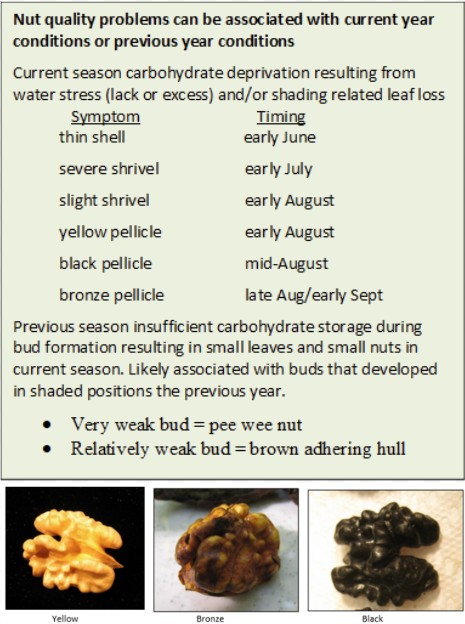 Why do these quality problems occur?
Kernel shrivel is most often caused by either shortage or excess of water. Insect damage and sunburn may also cause shrivel.
UC research trials have shown that carbohydrate deprivation can cause darkening of the kernel pellicle. It can result from either excess or lack of water. Historically, dark kernel color has been associated with water-stressed trees resulting from under-irrigation. However, more recent research has shown that it is now most often associated with trees that are wetter than the midday stem water potential fully watered baseline in mid to late summer. Darkening from carbohydrate deprivation can also be caused by shaded conditions in the inner canopy as orchards age. Heavy pruning results in a denser canopy that can exacerbate inner canopy quality problems.
Howard and Tulare are very sensitive to pellicle color problems due to carbohydrate deprivation resulting from either poor irrigation management and/or shading. Chandler is less sensitive to these problems.
Irrigation Management is the Key:
Many growers spray with kaolin clay to reduce sunburn and optimize kernel quality. Unfortunately, in five UC studies lead by Bruce Lampinen, no economic benefits were found with these applications. Instead, optimal kernel color is best achieved by maintaining orchards at a midday stem water potential of approximately 2 bars below the baseline (more dry) during mid- to late summer. Maximize your profits by paying attention to water management all season long. We have resources on adopting the pressure chamber. You can also ask your local farm advisor to come out and take pressure chamber readings for you.
Leave a Reply