


Luke Milliron, UCCE Farm Advisor, Butte, Glenn and Tehama Counties
Franz Niederholzer, UCCE Farm Advisor, Colusa and Sutter/Yuba Counties
Hull Split: High Stakes
The start of hull split is the most critical timing for navel orangeworm and hull rot control. How hull split proceeds is part of determining any water/energy savings, as well as your crop’s susceptibility to NOW damage and how cleanly your trees will shake. Success or trouble during hull split is a big part of the orchard’s financial success or disappointment. Every hull split season poses different challenges as you navigate a delicate dance between your trees, Mother Nature, and farming logistics.
An Early Hull Split?
Nonpareil hull split was underway early this year in parts of the Sacramento Valley. In late June many orchards on the west side of the valley had entered hull split, which is defined as 1% of the hulls in a tree reaching the 2C stage (Figure 1). Tree age, variety (older / newer varieties), rootstock, water stress and nitrogen status play important roles in timing the start of hull split. Nonpareil, on a low vigor rootstock like Rootpac-R, with low nitrogen, and moderate water stress will enter split very early. Conversely, Monterey or Fritz on a vigorous peach-almond hybrid like Hansen 536 and provided high nitrogen will be among the last trees to enter hull split.
Hull Split Duration:
The general rule is that hull split (1% to 100% 2C or greater, see figure 1) lasts 3 to 4 weeks but what determines exactly how long? Variety (older / newer varieties), rootstock, nitrogen, and water status all influence how fast hulls will split. From a NOW management perspective, you ideally want a fast, uniform hull split across the orchard leading to an earlier shake and minimizing the window for NOW egg laying on split nuts. However, from a marketable yield perspective, it is possible for hull split to be too short. Water stress between early June and the start of hull split means the hulls have the potential for a very fast split because they are entering the period with less water content. If hull split is too short a disruption of carbohydrates can increase shrivel. Conversely, excessive water stress during hull split can stall the split process by causing hull-tights. Excessive water stress during hull split can also increase mites, increase stick-tights, decrease kernel weight, and cause defoliation affecting next year’s bloom. Excessive leaf nitrogen can also extend the duration of hull split. A recipe for a long, drawn-out hull split is high leaf nitrogen, and lots of water. High nitrogen and water conditions can also be a recipe for hull hot, uneven split across the orchard, and increased navel orangeworm susceptibility.
Getting Specific about Water Stress during Hull Split:
In the hull split duration discussion above we mention the need to avoid both extreme water stress and excess during hull split but how do you go about doing that? The oldest and most basic way of judging water stress is simply looking at the tree. A water stressed almond tree will have drooping leaves and after severe water stress in almond there is yellowing and drop of leaves in the interior canopy, particularly the smallest “guard” leaves (figure 2). Often by the time water stress is seen in the tree unwanted consequences have already occurred, making visual symptoms a poor irrigation management approach.
With visual symptoms often arriving too late to avoid unwanted consequences, irrigation management with stem water potential readings from the pressure chamber/pressure bomb is the way to dial in irrigation during this critical period. A carefully regulated deficit irrigation (RDI) guided by the pressure chamber can reduce hull rot, save water/pumping costs, make hull split more uniform, and increase harvestability. Once blanks begin to split (1-2 weeks before 1% 2C and the official start of hull split on sound nuts) irrigation sets can be shortened to achieve moderate water stress, with stem water potential (SWP) readings with the goal of trees reaching -14 to -16 bars of stress before the next irrigation. The percentage irrigation sets are shortened by will depend on the water stress in the orchard ahead of hull split, with some orchards already at -14 bars and requiring no reduction in set length while others may require as much as a 1/3 reduction in set length. Full irrigation is resumed between 90% split and your irrigation cut off ahead of harvest. The increased irrigation improves split and reduces hull tights. RDI is NOT FOR EVERYONE. One reason to not do RDI is not owning a pressure chamber or an automated tree sensor that would allow you to measure tree water status and avoid excessive stress. A second reason to not do this deficit is because you are already behind on irrigation and trees are exhibiting stress. A final reason RDI isn’t for you in 2025 is your main variety (e.g. Nonpareil or Independence) is already at or near the 90% split where full irrigation is resumed. Although there are significant advantages to RDI, and it’s a crucial tool if hull rot is reducing your orchard’s yield potential by killing spur wood, there is a small cost in the form of slightly reduced kernel weight (e.g. -2.5% dry mass), and increased severe shrivel (e.g. +4 %).
Whether you did RDI or not, provide full irrigation between 90% split and your irrigation cut off ahead of harvest. This imposed water stress ahead of shaking to help reduce barking can also be accomplished by shortening irrigation set length to achieve -15 to -18 bars water stress. After shaking irrigate as soon as possible. If wetting nuts is a concern, a single dripline can be a great investment in microsprinkler and solid set irrigation orchards to avoid unwanted consequences from severe water stress while hulls are drying on the orchard floor.
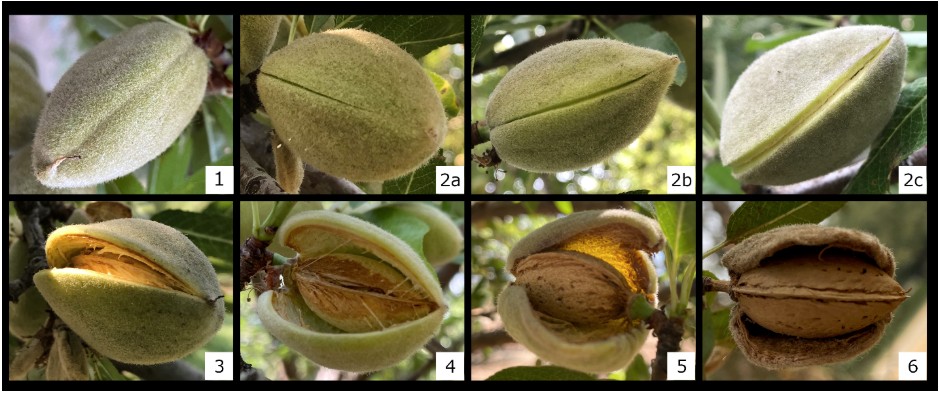
Figure 1. Almond hull split stages (photographs by C. Reyes and L. Milliron)
1. No separation of suture
2A. Less than 50% of suture line separated.
2B. Deep V over 50% of suture line separated, hull cannot be squeezed open.
2C. Deep V over entire suture line, can be squeezed open by pressing opposite ends of the hull
3. Suture opening less than 1 cm in width, exposed shell; visible brown edge along split edge of hull when observed from beneath the canopy.
4. Suture opening more than 1 cm in width, fully exposed shell.
5. Hull edges begin to dry, shell changes from white to brown
6. Completely dry hull, brown shell
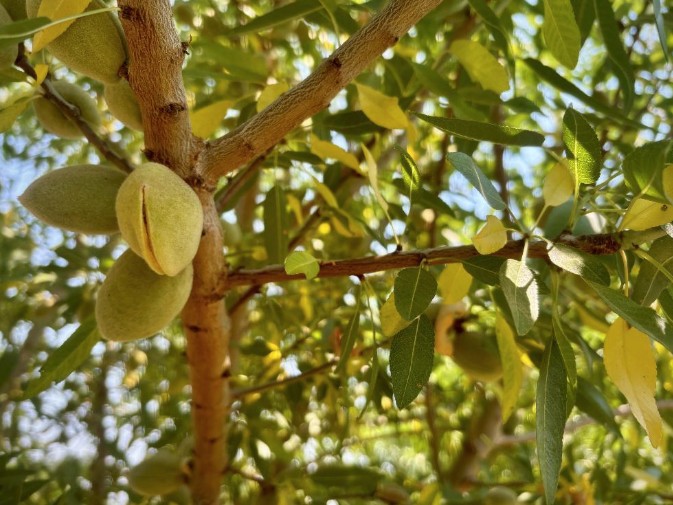
Figure 2. Severe water stress in almond causes yellowing and drop of leaves in the interior canopy, particularly the smallest “guard” leaves. Often by the time water stress is seen in the tree unwanted consequences have already occurred, making visual symptoms a poor irrigation management approach (photo Luke Milliron).
Leave a Reply