


Jaime Ott, UCCE Tehama, Shasta, Glenn, and Butte Counties
Though our weather outlook for the next couple of months is leaning toward warmer weather than usual, a cold snap during bloom and leaf-out could cause significant bacterial blast damage. Make a plan now in case of bad weather.
The Bottom Line:
- Bacterial blast can be a problem when cold, wet weather coincides with bloom or leaf-out.
- Copper resistance is common: spraying copper is ineffective for preventing blast.
- Frost protection is the most economical prevention option and will help prevent damage from both frost and bacterial blast.
- The antibiotic kasugamycin (Kasumin®) is effective for preventing blast when applied up to 6 days before cold, wet weather. It is available this year under Section 18 exemption (Feb 1- Apri 15), consult with your PCA regarding rates and timings.
The Details:
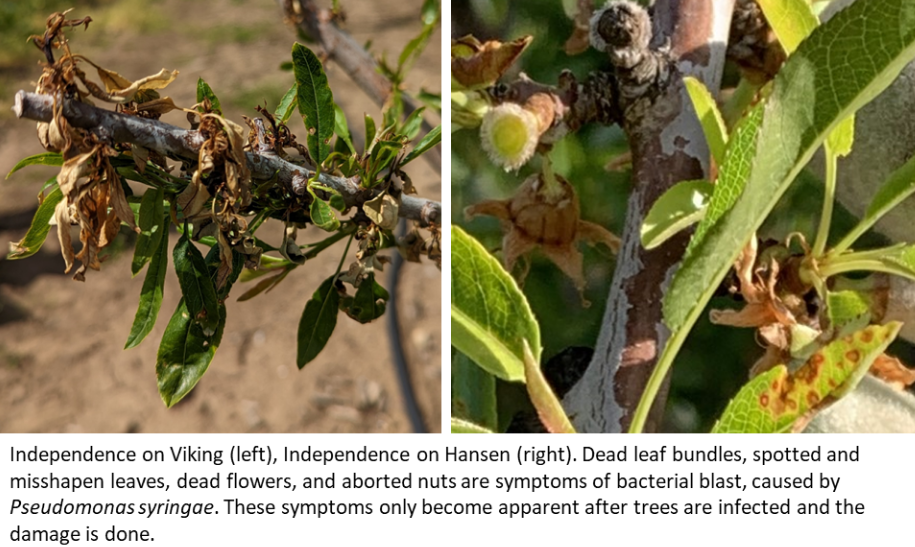
Pseudomonas syringae can infect all aboveground parts of an almond tree, causing bacterial blast of the leaves and flowers. Pseudomonas is everywhere, so weather conditions are the factor driving this disease. Freezing cold, wet weather favors this disease. Pseudomonas is spread by water hitting the tree. If this occurs during frost, Pseudomonas can enter the tree through cells broken by frost damage. Trees are especially susceptible to frost damage during bloom and leaf-out, when tender new growth is exposed to cold weather.
Preventing infection by Pseudomonas is the only way to control bacterial blast. Frost protection is the most inexpensive strategy: if the trees are not damaged by frost, Pseudomonas will not have a way in to cause disease. As a second line of defense, kasugamycin (Kasumin®) is effective to prevent bacterial blast when applied no more than 6 days before cold, wet weather. For this spray, complete coverage is crucial: all the tender new growth must be covered in a protective layer of the antibiotic for it to be effective. Any tissue left uncovered will be unprotected. Kasugamycin recently received a Section 18 for use in almond between February 1 and April 15, 2026. If the weather warrants treatment, kasugamycin can be used as a preventative spray up to two times during the temporary use window. Current work by UC researchers shows that copper-resistance is common in Pseudomonas throughout the state. In some cases, mixing mancozeb with the copper may provide some level of control, but research shows that this mixture is not as effective as kasugamycin and can cause phytotoxicity.
For more information on bacterial blast, check out these articles at www.sacvalleyorchards.com
Bacterial blast/canker: What do we know?
Leave a Reply