


North Sac Valley: Jaime Ott, Orchard Advisor, UCCE Tehama, Shasta, Glenn, Butte Counties
This year, full bloom in the northern Sacramento Valley was around March 23-25. Though we had average chilling this winter (72 chill portions by March 1st at the Gerber South CIMIS station), the weather heated up during bloom, with daily maximum temperatures around 85oF (Figure 1). Bloom density was variable from orchard to orchard, and fruit set was very hit-and-miss: most of the orchards we tracked were 30-35% fruit set, some were around 20%, and some below 10%. This led to a year where some orchards had to be heavily thinned and others didn’t have enough fruit to harvest.
Though the spring felt mild, with fairly low high temps during the day, the Growing Degree Hours 30 days after bloom (GDH30) in Tehama, Glenn, and Butte counties was high this year (7700-8100), driven by the fact that the nights were relatively warm. This suggested that we would have an early harvest and slightly lower sizing potential. However, we had a mild summer, and final green fruit sizes at harvest were slightly larger than what we saw last year (Figure 2), and well in line with what we have measured since 2021. While there was some sunburn in several orchards, we saw nothing like the blue prune drop from 2024. Overall, it looks like we had a good crop with reasonable size.
South Sac Valley: Franz Niederholzer, Orchard Advisor, UCCE, Colusa, Sutter, Yuba Counties
In the Feather River prune growing region (Sutter, Yuba, and south Butte Counties), the season started out looking “normal”. Chilling (78 chill portions by March 1 at the Verona CIMIS station) and full bloom timing (March 23-25) were right about recent averages. Bloom was not early, but temperatures spiked up dramatically right at full bloom, going from around 70oF to almost 90oF in 3 days before dropping 20 degrees in two days to back under 70oF. Surprisingly, fruit set was very good (30-40%) in several orchards that saw almost 90oF right at full bloom. There were also orchards in the area where there was very little fruit set. It may be possible that the low set in some orchards was due to some slight difference in bloom timing compared to others as the spike in temperatures was very short lived. It’s hard to know, exactly, what caused the dramatic differences in fruit set this year.
Spring 2025 weather was the usual temperature yo-yo in a wet spring with ±25oF swings in maximum daily temperatures from late March into early Mary. The post bloom heat units measured as cumulative Growing Degree Hours 30 days after bloom (GDH30) for Sutter Co in 2025 were higher (7460) compared to 2024 (6150). A higher GDH total is reported to advance harvest and generally limit fruit size potential, but as mentioned in the North Valley update, the 2025 crop size potential was good. The much cooler summer of 2025 compared to 2024 might help explain the difference. Reference date, 2025 in the Yuba City area was May 8, just a couple of days earlier than 2024.
The 2025 crop had very high fruit sugar levels; based on the orchards I checked and conversations with industry field reps. This may have been due to the cooler summer temperatures in 2025 compared to 2024, especially in July. See Figure 3 for a day-to-day comparison of maximum temperatures in 2024 vs 2025.
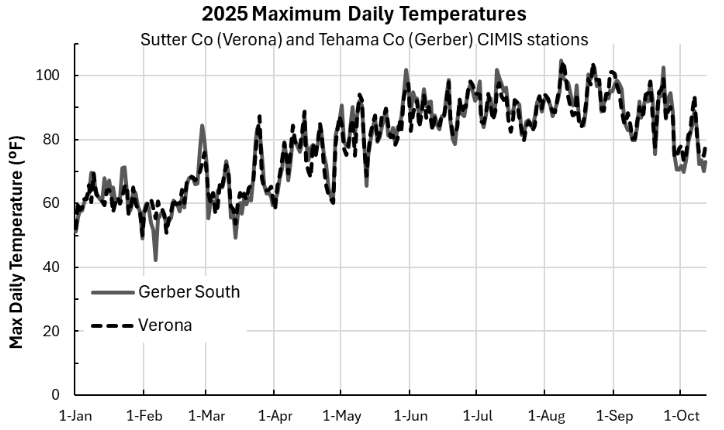
Figure 1. 2025 temperatures. Full bloom was around March 23 in Tehama Co. and March 23-25 in Sutter Co.
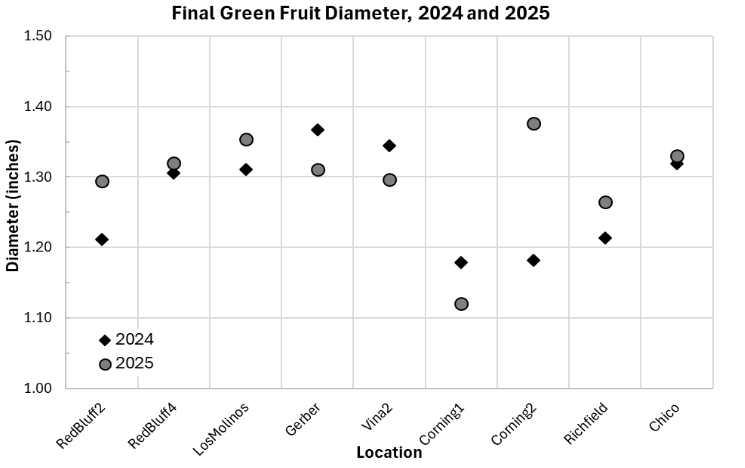
Figure 2. 2024 and 2025 final fruit size for nine orchards in the Northern Sac Valley. Average diameter for 2024 was 1.27 inches, and average diameter for 2025 was 1.30 inches
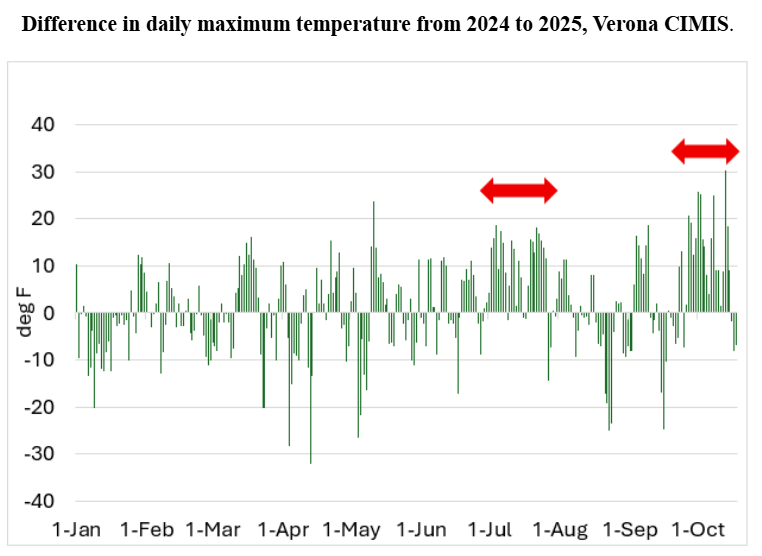
Figure 3. Comparison of maximum temperatures for the same calendar day, 2024 vs 2025 in southern Sutter Co (Verona CIMIS). Where the 2024 max temperature was higher than the 2025 max temperature for that same calendar day, the value is positive and it’s negative where the temp was higher in 2025 than 2024. Two heat waves in 2024 are shown with red lines.
Leave a Reply