


Jaime Ott, UCCE Tehama, Shasta Glenn, Butte Counties
The Bottom Line:
- – Despite warm weather near Improved French bloom, most orchards have a heavy crop this year.
- – We have high GDH30 values, so expect an early harvest and poor crop sizing.
- – To maximize fruit size despite the warm weather, consider thinning before reference date and targeting a modest cropload.
The Details
This year, despite warm temperatures during our Improved French Bloom, most orchards have a heavy crop. We consider temperatures above 80ºF during and just after bloom to be potentially damaging to the crop. Orchards in the Red Bluff area reached full bloom around March 9th and 10th, with daily highs at or just under 80ºF. On March 13th the daily high was around 84ºF, and the highs remained above 80ºF for the next several days (Figure 1). Bloom was very strong, likely due to the balmy summer we had last year which allowed many flower buds to set. The good chilling this winter, followed by the warm temperatures, meant that the bloom was compact and only lasted about a week in most orchards. While the warm temperatures just after bloom caused some concern, we had excellent set, ranging from 25% to 50% set in the four orchards I measured. This high set, coupled with the strong bloom overall, means that most orchards have a crop that will require extensive thinning to maximize fruit size and grower returns.
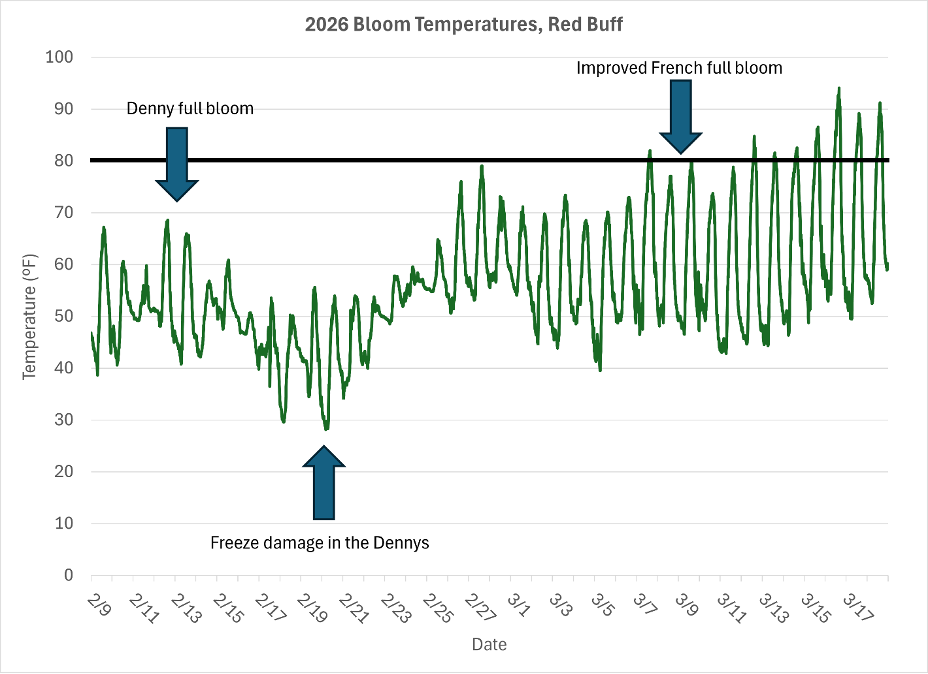
Figure 1. Temperatures in Red Bluff during and after bloom for Denny and Improved French. The warm weather 3-4 days after full bloom in Improved French did not affect crop set. The cold weather a week after Denny full bloom caused crop damage.
Since bloom, the relatively warm weather has led to a high GDH30 this year, which predicts an early harvest and poor crop sizing. We are over 8,200 growing degree hours in the 30 days after bloom (GDH30). Any year where we are over 6,000 is considered a “high” year. In years with high GDH30 values, harvest timing tends to be earlier. Couple this with our early bloom, and we expect harvest several weeks earlier than last year. Years with high GDH30 values also can lead to poor fruit sizing during the season. Last year our GDH30 was high (around 7,700), but the mild summer still allowed for good fruit size gain. This year, the GDH30 is even higher, and we should not count on mild summer weather to size the fruit. Managing cropload is your main tool for ensuring good fruit size despite the weather.
Given the heavy crops in most orchards and the high GDH30 predicting early harvest and poor fruit sizing, this is not a year to ignore your thinning program. Reference date will be early, and you don’t want to give up precious size gain by waiting until after that to thin. I was in an orchard last week where we counted over 10,000 pieces of fruit per tree—after shaking as hard as we could to strip the tree, we still had over 2,000 pieces of fruit remaining. This is a year to consider thinning early and hard to target the lower end of what your trees can do.
Visit SacValleyOrchards.com for more information on heat at bloom, thinning, and GDH30:
Bloom weather and prune fruit set: what we know so far
Checking cropload and shaker thinning prunes
Technology Spotlight: Cropload Estimation in Prunes
GDH30 for 2025: where we stand and what is means
Leave a Reply